
How Much Does Salesforce Cost in 2026? Real Pricing for US Businesses
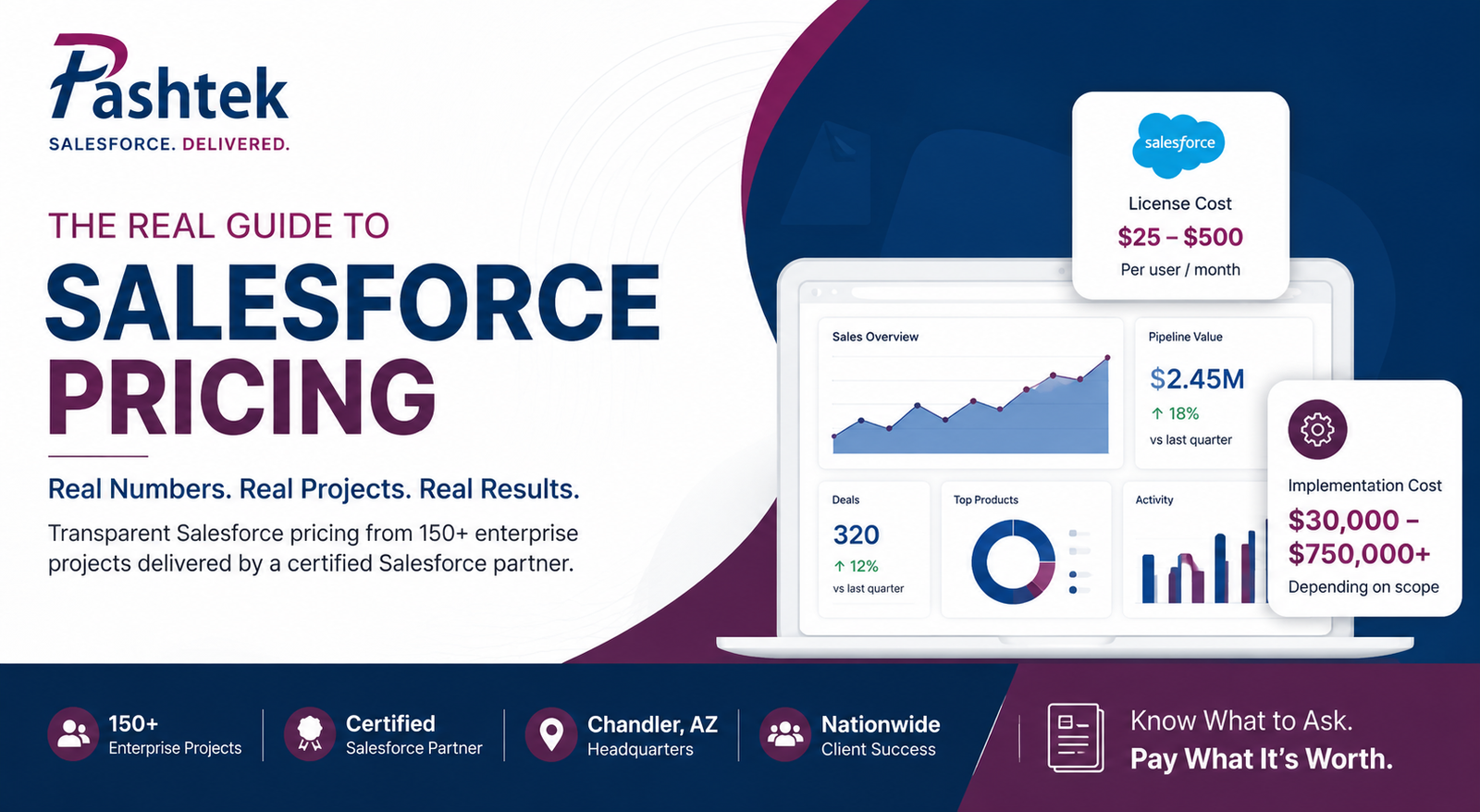
Most Salesforce consulting firms dodge the “how much does Salesforce cost” question because the honest answer requires math they’d rather do behind closed doors. Here’s the real pricing: Salesforce licenses cost between $25 and $500 per user per month, and implementation costs between $30,000 and $750,000+ depending on scope. Full breakdown below real numbers from 150+ enterprise projects delivered by Pashtek, a certified Salesforce partner in Chandler, AZ.
How much does Salesforce cost?
Salesforce has two cost buckets: license cost (monthly per user) and implementation cost (one-time setup).
Salesforce license cost per user (2026):
| Salesforce Edition | Cost per user/month | Best for |
|---|---|---|
| Sales/Service Cloud Starter | $25 | Very small teams (under 10 users) |
| Sales/Service Cloud Pro | $75 | Small businesses (10–50 users) |
| Sales/Service Cloud Enterprise | $165 | Mid-market (100–500 users) |
| Sales/Service Cloud Unlimited | $330 | Complex enterprise |
| Einstein 1 Sales / Service | $500 | AI-powered enterprise |
| Marketing Cloud Engagement | $1,250/mo (bundle) | Marketing teams |
Salesforce implementation cost:
| Project Type | Company Size | Typical Cost | Timeline |
|---|---|---|---|
| Sales Cloud only, basic | 20–50 users | $30,000 – $75,000 | 8–12 weeks |
| Sales Cloud + Service Cloud | 100–250 users | $75,000 – $175,000 | 12–20 weeks |
| Multi-cloud + integrations | 250–500 users | $175,000 – $350,000 | 4–6 months |
| Enterprise + SAP/ERP integration | 500+ users | $350,000 – $750,000+ | 6–12 months |
Add $15,000 – $80,000/year for Salesforce managed services after go-live if you don’t have an in-house admin.
These are Pashtek’s actual project ranges across enterprise clients in Phoenix, Scottsdale, Dallas, Chicago, and nationwide. Most other firms won’t quote a real range they’ll ask for a discovery call and hand you an inflated estimate. This guide explains what drives cost so you know what to ask for.
The 7 factors that drive Salesforce cost
Pricing varies wildly across Salesforce consulting firms because these variables move dramatically. Here’s what actually matters.
1. Which Salesforce cloud editions you need
Sales Cloud costs less to implement than Service Cloud. Service Cloud costs less than Marketing Cloud. And any single-cloud implementation costs less than a multi-cloud engagement where the clouds need to share data.
Rough cost ranges by cloud (implementation only, not license):
- Sales Cloud: $25,000 – $150,000
- Service Cloud: $30,000 – $200,000
- Marketing Cloud: $50,000 – $250,000
- Salesforce CPQ: $50,000 – $250,000 (highly variable based on product complexity)
- Experience Cloud (Communities): $40,000 – $180,000
- Manufacturing Cloud: $75,000 – $350,000
- Health Cloud: $80,000 – $400,000
- Nonprofit Cloud (NPSP): $25,000 – $100,000
- Government Cloud: $150,000+ (FedRAMP compliance adds cost)
Multi-cloud engagements aren’t just additive. Sharing data between Sales Cloud, Service Cloud, and Marketing Cloud requires additional data architecture, sharing rules, and integration work usually 15–25% additional cost.
2. Number of custom objects and automations
Every custom object, custom field, validation rule, Flow, Apex trigger, and Lightning Web Component adds cost. A typical enterprise Salesforce implementation includes:
- 8–20 custom objects
- 40–100 custom fields
- 15–30 Flows and Process Builder automations
- 5–15 Apex classes or triggers
- 3–8 Lightning Web Components
Each hour of certified Salesforce development in the U.S. runs $150–$250/hour. Complex customization projects easily add $50,000 – $150,000 to a base implementation.
3. Data migration complexity
Migrating from an existing CRM is often the most underestimated cost. Ranges:
- Simple migration (HubSpot, Zoho, spreadsheets clean data, under 100K records): $8,000 – $20,000
- Medium migration (Microsoft Dynamics, Zendesk, mixed data quality): $20,000 – $60,000
- Complex migration (Siebel, custom databases, dirty data, complex relationships): $60,000 – $200,000+
Migrations from legacy Siebel, custom Oracle databases, or ancient FoxPro/Access systems are always more expensive because data cleansing, relationship mapping, and validation dominate the effort.
4. Integration requirements
Connecting Salesforce to your ERP, finance system, marketing automation, or custom apps drives significant cost. Typical integration price ranges:
- Simple integrations (email marketing, e-signature, single API): $5,000 – $15,000 each
- Medium integrations (accounting, HRIS, warehouse management): $15,000 – $50,000 each
- ERP integration (SAP–Salesforce, Oracle, NetSuite): $60,000 – $250,000+
- MuleSoft Anypoint Platform implementation: $100,000 – $400,000+ for enterprise API-led architecture
If you need bidirectional real-time sync between Salesforce and your ERP, budget $80,000 minimum this is where most implementations blow their budget.
5. Data volume and org complexity
Higher data volumes force different architectural decisions. A Salesforce org with 5 million records requires different indexing, sharing rules, and archival strategy than an org with 50,000 records. Complexity scales non-linearly.
- Under 100K records: standard architecture
- 100K–1M records: careful indexing needed
- 1M–10M records: partitioning, LDV strategies, additional storage
- 10M+ records: Big Objects, external data sources, custom indexing
Large orgs typically add 20–40% to implementation cost.
6. Training and change management
Rolling out Salesforce to 500 users without proper training is how implementations fail after go-live. Training investment ranges:
- Basic training (self-service Trailhead + docs): included
- Live training sessions (role-based, 4–8 sessions): $8,000 – $25,000
- Comprehensive change management (adoption program, executive comms, coaching): $30,000 – $100,000+
Skimping here is why implementations get adopted by only 40% of users. Budget at least 8% of implementation cost for training and change management.
7. Post go-live support model
After go-live you need someone maintaining the org. Options:
- In-house Salesforce admin salary (US): $85,000 – $130,000/year loaded
- Offshore admin (India, LATAM): $30,000 – $50,000/year but time zone gaps
- Salesforce managed services retainer (US-based like Pashtek): $28,800 – $96,000/year depending on hours needed
For most mid-market companies, managed services is cheaper than hiring in-house you get certified expertise across multiple specialists (admin, developer, integration architect) without the full-time cost.
Cost breakdown by cloud edition
Salesforce Sales Cloud cost
Typical range: $30,000 – $150,000
Sales Cloud is the most common starting point. A basic Sales Cloud implementation for a 50–100 user B2B sales team usually includes:
- Lead management and web-to-lead setup
- Opportunity pipeline with 5–8 sales stages
- Account and contact management with custom fields
- 2–3 reports and dashboards for sales leaders
- Salesforce forecasting setup
- Basic email integration (Gmail or Outlook)
- User training
Costs increase when you add territory management, product catalog, quote generation (CPQ), custom sales methodology stages, or third-party integrations.
Pashtek Sales Cloud project range (last 24 months): $42,000 – $187,000 Median cost: $88,000 Median timeline: 14 weeks
Salesforce Service Cloud cost
Typical range: $40,000 – $200,000
Service Cloud implementations are usually more complex because they involve case routing, knowledge management, and often integration with telephony (CTI) systems.
A standard Service Cloud implementation includes:
- Case management with automated routing
- Omni-channel setup (email, web form, chat)
- Knowledge base with articles
- Service Console configuration
- CSAT and CES survey setup
- Reports and dashboards
- User training
Add cost for field service (Field Service Lightning), CTI integration ($15K–$50K), advanced Einstein Case Classification, chatbot (Einstein Bots), or Experience Cloud community.
Salesforce CPQ cost
Typical range: $50,000 – $250,000
Salesforce CPQ (Configure, Price, Quote) is one of the most variable pricing engagements because product configuration complexity varies wildly across industries. Cost drivers:
- Number of products (10 vs 10,000)
- Bundle configurations
- Pricing rules (discounts, block pricing, tiered pricing)
- Approval workflows
- Contract renewal automation
- ERP integration for pricing sync
CPQ implementations for B2B manufacturers with complex bundles routinely hit $150,000–$400,000. See our full breakdown at Salesforce CPQ Implementation.
Marketing Cloud cost
Typical range: $50,000 – $300,000
Marketing Cloud is usually the most expensive Salesforce cloud to implement because it requires setting up data extensions, journey builder templates, email templates, mobile studio, and often Salesforce CDP (Customer Data Platform) integration.
Enterprise B2C Marketing Cloud implementations regularly exceed $250,000.
Manufacturing Cloud cost
Typical range: $75,000 – $350,000
Salesforce Manufacturing Cloud sits on top of Sales Cloud and adds Sales Agreements, account-based forecasting, and rebate management. Cost drivers:
- Number of key accounts on Sales Agreements
- ERP integration (SAP is common -adds $80K+)
- Partner community for dealers/distributors
- Manufacturing Cloud Analytics
Median manufacturing cloud project cost in Pashtek’s book: $145,000.
Health Cloud cost
Typical range: $80,000 – $400,000
Health Cloud requires HIPAA compliance work, EHR integration (Epic, Cerner), and patient portal setup. Compliance and integration dominate costs.
Nonprofit Cloud (NPSP) cost
Typical range: $25,000 – $100,000
Nonprofit Cloud is cheaper for two reasons: NPSP is a free managed package on top of standard Salesforce, and nonprofits get 10 free Salesforce licenses through the Power of Us Program.
Data migration from Raiser’s Edge or Blackbaud is usually the biggest cost driver.
Cost by company size
Small business (10–50 users)
Total investment: $30,000 – $80,000 first year
- Salesforce license: $75–$165 per user/month
- Implementation: $30,000 – $60,000
- First-year total: $40,000 – $80,000+ depending on customizations
Best for growing B2B companies replacing spreadsheets or HubSpot.
Mid-market (100–250 users)
Total investment: $150,000 – $500,000 first year
- Salesforce license: $180–$330 per user/month
- Implementation: $100,000 – $250,000
- Ongoing managed services: $30,000 – $60,000/year
Best for companies with dedicated sales ops, multiple product lines, or integration needs.
Enterprise (500+ users)
Total investment: $500,000 – $2,000,000+ first year
- Salesforce license: $330–$500+ per user/month
- Implementation: $250,000 – $750,000+
- ERP integration: $80,000 – $300,000+
- Ongoing managed services: $80,000 – $200,000/year
Best for enterprise organizations with complex processes, multiple divisions, and enterprise ERP.
How Much is Salesforce Per Month?
Salesforce cost per month depends on user count and edition. Here’s what you’ll pay monthly for a typical B2B company:
| Company Size | Users | Edition | Monthly Cost |
|---|---|---|---|
| Small business | 10 users | Sales Cloud Pro ($75/user) | $750/month |
| Growing SMB | 50 users | Sales Cloud Enterprise ($165/user) | $8,250/month |
| Mid-market | 200 users | Sales Cloud Enterprise ($165/user) | $33,000/month |
| Enterprise | 500 users | Sales/Service Unlimited ($330/user) | $165,000/month |
Monthly cost formula: (Number of users) × (Per-user monthly cost) = Total monthly Salesforce cost
Add $2,400 – $8,000/month for Salesforce managed services if you don’t have an in-house admin.
Salesforce cost vs HubSpot cost (2026 comparison)
Both are enterprise CRMs but with different pricing models. Rough comparison at the same feature level:
| Component | Salesforce | HubSpot |
|---|---|---|
| Entry-level per user/month | $25 (Starter) | Free tier available |
| Pro tier per user/month | $75 | $90 (Sales Hub Pro) |
| Enterprise tier per user/month | $165 | $150 (Sales Hub Enterprise) |
| Marketing platform starting cost | $1,250/mo | $890/mo (Marketing Pro) |
| Implementation cost range | $30K – $750K+ | $10K – $150K |
| Customization ceiling | Very high (Apex, LWC, custom objects) | Moderate (limited by platform) |
| Best for | Enterprise, custom processes, ERP integration | SMB to mid-market, standard sales/marketing |
Bottom line: HubSpot is cheaper for teams under 50 users with standard sales processes. Salesforce is worth the extra cost for enterprises with custom processes, industry-specific needs (manufacturing, financial services, healthcare), or complex integrations with ERP systems like SAP or Oracle.
Pashtek specializes in migrating companies from HubSpot to Salesforce when they’ve outgrown HubSpot’s customization ceiling. Typical migration cost: $20,000 – $60,000 depending on data volume.
Fixed-Price vs Time & Materials Which Saves More?
Most Salesforce consulting firms will quote either fixed-price or time & materials (T&M). Here’s how to think about it.
Fixed-price implementations
- Pros: Predictable budget, consultant absorbs scope creep risk, forces disciplined discovery
- Cons: Requires clear scope upfront, changes cost extra, less flexible
Best for well-defined implementations, replacing a specific legacy CRM, multi-cloud with known integrations.
Pashtek’s approach: After a discovery workshop (free, 2–4 hours), we provide a fixed-price proposal. Scope changes require change orders but you always know before work starts. No surprise invoices.
Time & materials (T&M)
- Pros: Flexible for evolving scope, adjust as you learn, useful for enhancement projects
- Cons: Cost can balloon, requires strong project management, budget uncertainty
Best for unclear scope, R&D projects, ongoing enhancements, managed services retainers.
Our recommendation: Fixed-price for the initial implementation. T&M for enhancements after go-live.
Average Total Cost of a CRM Consulting Engagement (Full Sales Cloud Implementation)
For a full Sales Cloud implementation, the average total cost of a CRM consulting engagement in the US ranges from $88,000 to $175,000 for mid-market clients (100–250 users). Enterprise engagements with multi-cloud, SAP integration, or complex data migration run $250,000 to $750,000+.
CRM Consulting Engagement Cost Breakdown
- Discovery workshop: Free (Pashtek) or $10K–$25K (Big 4 firms like Deloitte, Accenture)
- Configuration & build: $45K–$100K for mid-market Sales Cloud
- Data migration: $8K–$60K depending on legacy CRM (Siebel, Dynamics, HubSpot)
- Integration: $15K–$50K per external system (SAP, Oracle, DocuSign)
- Training & change management: $8K–$25K
- 90-day hypercare: Included at Pashtek, extra at Big 4 firms
Pashtek Median CRM Consulting Engagement
$88,000 over 14 weeks for a 100–200 user full Sales Cloud implementation. Compared to Big 4 firms typically quoting $150K–$300K for identical scope.
Get a fixed-price CRM consulting quote →
Salesforce Consulting Rates (2026 US Market)
Salesforce consulting rates in the US market vary by consultant seniority and firm type. Here’s the current 2026 breakdown:
| Consultant Level | Hourly Rate | Best For |
|---|---|---|
| Junior Consultant | $100 – $150/hr | Basic admin tasks, reports, dashboards |
| Senior Consultant | $150 – $200/hr | Custom development, integrations |
| Salesforce Architect | $200 – $300/hr | Enterprise architecture, complex projects |
| Big 4 Firms | $250 – $450/hr | Enterprise transformations (Deloitte, Accenture, IBM) |
| Offshore Consultants | $30 – $80/hr | Basic dev with time zone tradeoffs |
Pashtek Salesforce consulting rates: $150–$250/hour — competitive for US-based certified partners, 20–30% below Big 4 firms.
Hidden costs that surprise most Salesforce buyers
Six line items that inflate implementations 20–40% if not budgeted upfront.
1. Salesforce license costs
Implementation cost is not license cost. Salesforce licenses run $75–$500 per user per month depending on edition. A 200-user Sales Cloud Enterprise deployment costs $396,000/year in licenses alone. Budget this separately.
2. Third-party AppExchange apps
Most implementations end up buying 2–5 AppExchange apps: DocuSign, Conga (document generation), an add-on reporting tool, a data enrichment tool. Budget $10,000 – $50,000/year for AppExchange licenses.
3. Data storage upgrades
Salesforce includes 10 GB of data storage. Enterprise orgs with attachment-heavy processes routinely blow past this and buy additional storage at $125/GB/year.
4. Sandbox costs
Enterprise sandboxes (Partial Copy, Full) cost extra. A Full Sandbox for a large org runs $30,000+/year and is essential for realistic testing.
5. Ongoing training
Onboarding new hires and running refresher training doesn’t stop at go-live. Budget $8,000 – $25,000/year for ongoing training programs.
6. Post go-live support
The org that isn’t maintained decays. Whether you hire in-house or use managed services, budget $30,000 – $100,000/year minimum.
Real Pashtek Project Examples
Actual project prices from Pashtek’s book to give you calibration.
Phoenix manufacturer – discrete manufacturing
- Scope: Sales Cloud + Manufacturing Cloud + SAP integration
- Users: 85 sales reps + 40 operations users
- Timeline: 14 weeks
- Investment: $187,000 fixed price
- Outcome: 22% sales cycle reduction post go-live
Chicago distributor – wholesale distribution
- Scope: Service Cloud + SAP–Salesforce bidirectional integration via MuleSoft
- Users: 220 users
- Timeline: 18 weeks
- Investment: $312,000 fixed price
- Outcome: Deal cycle reduced from 18 days to 6
Dallas logistics – field service operations
- Scope: Service Cloud + Field Service Lightning + Mobiform offline mobile forms
- Users: 340 field techs + 60 dispatchers
- Timeline: 16 weeks
- Investment: $268,000 fixed price
- Outcome: 60-day ROI on Mobiform, 80% reduction in field data entry time
National nonprofit- donor management
- Scope: Nonprofit Cloud (NPSP) implementation + Raiser’s Edge migration
- Users: 45 development team members
- Timeline: 12 weeks
- Investment: $74,000 fixed price
- Outcome: 35% increase in online donation conversion, 200K+ donor records migrated
Why Salesforce cost estimates from other firms vary so wildly?
If you’ve gotten Salesforce implementation quotes from 3 firms, you’ve probably seen 3 wildly different numbers sometimes 4x variance for the same scope. Here’s why.
Offshore vs onshore delivery. An Indian or LATAM implementation partner may quote $40,000 for what a US-based firm quotes $150,000. The delta is real but so is the difference in delivery: same time zone, English-first communication, and on-site availability. Pashtek is US-based in Chandler, AZ, which affects our pricing but also our project outcomes.
Fixed-price vs hourly billing. Firms that quote low hourly rates often win the deal, then rack up hours during “discovery” and “scope refinement.” Firms that quote fixed prices have to price defensively. Ask any firm quoting hourly: “What’s your typical project total for a Sales Cloud implementation of 100 users?” if they can’t answer, walk away.
What’s actually in scope. Some firms exclude data migration, training, or hypercare from their base quote then charge for them separately. Always ask for a line-item scope breakdown. Pashtek’s fixed-price proposals include everything up front.
How to get an Accurate Salesforce Cost Quote?
Any consulting partner asking for a rough quote without discovery is either lowballing to win business (and will change-order you later) or overbidding to protect margin.
Here’s Pashtek’s process free of charge:
Step 1 – Free discovery workshop (2–4 hours) We meet with your team, map your current sales, service, and marketing processes against Salesforce capabilities, and identify integration touch points.
Step 2 – Written proposal within 5 business days Includes fixed-price scope, timeline, cloud recommendations, integration architecture, and a phased rollout plan.
Step 3 – Alignment meeting We walk through the proposal, answer questions, and revise if needed. No pressure.
Step 4 – Contract and kickoff If we’re a fit, we sign and start.
The whole discovery-to-proposal cycle takes 5–7 business days. Nothing costs anything until you sign.
Schedule your free Salesforce cost consultation →
Is Pashtek cost-effective compared to other Salesforce providers?
Pashtek is priced competitively for a US-based, certified Salesforce partner. Our project costs typically fall 20–30% below the “Big 4” consulting firms (Deloitte, Accenture, IBM, Capgemini) for equivalent scope, because we don’t carry their overhead no dedicated sales teams, no marketing pyramids, no rate-inflated senior partner sign-offs.
We’re priced higher than offshore-only firms because we deliver from Chandler, AZ with US-based certified consultants. For clients whose priority is time zone alignment, English-first communication, and on-site discovery, that premium is worth it.
Where Pashtek genuinely wins:
- Fixed-price proposals (not “estimates that triple”)
- US-based delivery from Chandler, AZ
- 10+ years of Salesforce specialization (150+ projects since 2014)
- SAP + Salesforce dual expertise (rare in the US market)
- Published case studies with real dollar outcomes
Request a fixed-price Salesforce implementation quote →
Frequently asked questions
How much does Salesforce cost per user?
Salesforce cost per user in 2026 ranges from $25/month (Starter edition) to $500/month (Einstein 1 Enterprise). Most B2B companies use Sales Cloud Enterprise at $165 per user per month this includes forecasting, custom reports, and unlimited custom objects. Marketing Cloud starts at $1,250/month for the base package rather than per-user pricing.
Is Salesforce cheaper than HubSpot?
For very small teams (under 20 users), HubSpot is cheaper. For mid-market and enterprise (100+ users), Salesforce is usually competitive when factoring in what’s included. HubSpot Professional runs $90 per user per month; Salesforce Enterprise runs $165 per user per month but includes deeper customization, unlimited automation, and industry editions like Manufacturing Cloud and Health Cloud that HubSpot doesn’t offer.
What are the hidden costs of Salesforce implementation?
Six hidden costs that inflate implementations 20–40% if not budgeted upfront:
- AppExchange apps — Most orgs buy 2–5 apps: DocuSign, Conga, data enrichment tools ($10K–$50K/year)
- Data storage overage — Salesforce includes 10 GB; enterprises exceed this at $125/GB/year
- Full sandbox — Required for realistic testing, $30K+/year for large orgs
- Ongoing training — New hire onboarding, $8K–$25K/year
- Post go-live admin — Managed services or in-house admin, $30K–$100K+/year
- Salesforce release management — 3 releases/year require sandbox testing and impact analysis
How Much is Salesforce Per Month?
Salesforce cost per month depends on user count and edition. Here’s what you’ll pay monthly for a typical B2B company:
| Company Size | Users | Edition | Monthly Cost |
|---|---|---|---|
| Small business | 10 users | Sales Cloud Pro ($75/user) | $750/month |
| Growing SMB | 50 users | Sales Cloud Enterprise ($165/user) | $8,250/month |
| Mid-market | 200 users | Sales Cloud Enterprise ($165/user) | $33,000/month |
| Enterprise | 500 users | Sales/Service Unlimited ($330/user) | $165,000/month |
Monthly cost formula: (Number of users) × (Per-user monthly cost) = Total monthly Salesforce cost
Add $2,400 – $8,000/month for Salesforce managed services if you don’t have an in-house admin.
Should I choose a fixed-price or hourly Salesforce implementation?
Fixed-price is better for well-defined implementations replacing a specific legacy CRM — predictable budget, consultant absorbs risk of scope creep, forces disciplined discovery upfront.
Hourly (Time & Materials) works better for evolving scope, R&D projects, and ongoing enhancements after go-live. Also standard for Salesforce managed services retainers.
Pashtek’s recommendation: fixed-price for the initial implementation, T&M for enhancements after go-live. This gives you budget predictability when you need it and flexibility when you don’t.
Is there a Salesforce implementation cost calculator I can use?
There’s no reliable public calculator because pricing depends on 7 variables: cloud editions, custom objects, integrations, data migration complexity, org size, training needs, and post go-live support. Any online calculator that quotes a specific price without asking about integrations and customization is oversimplifying.
Instead, get a fixed-price proposal after a free 2-hour discovery workshop. Pashtek delivers written proposals within 5 business days — no calculator required. Request yours here →
How much does Salesforce cost for a small business?
For a small business with 10–50 users, a basic Salesforce Sales Cloud implementation typically costs $30,000 to $60,000, plus license fees of $75–$165 per user per month. This covers configuration, basic data migration, integration with your email platform, and user training. Complex customizations, CPQ, or multi-cloud implementations increase cost significantly.
How much does Salesforce implementation cost for enterprise?
Enterprise Salesforce implementations (500+ users, multi-cloud, ERP integration) typically cost $350,000 – $750,000+. Full multi-cloud transformations including SAP–Salesforce integration and MuleSoft can exceed $1 million.
Why do Salesforce consultants charge so much?
Certified Salesforce consultants in the US bill $150–$250 per hour because Salesforce implementation requires specialized expertise across configuration, Apex development, integration, data migration, and change management. A single certified Salesforce architect with 10+ years experience is what separates a successful implementation from one that fails at go-live.
Is it cheaper to hire an in-house Salesforce admin?
For companies large enough to need 40+ hours per week of admin work — sometimes. A US-based in-house Salesforce admin costs $85,000 – $130,000 per year loaded. Below that threshold, Salesforce managed services is usually cheaper because you get access to certified admins, developers, and integration specialists without the full-time cost of any of them.
How long does a Salesforce implementation take?
A basic Sales Cloud implementation for 50–100 users takes 10–14 weeks. Multi-cloud enterprise implementations run 4–6 months. Complex SAP–Salesforce integration projects can run 6–12 months. Pashtek provides fixed timelines at the end of the discovery phase.
Do you offer Salesforce implementation in Arizona?
Yes. Pashtek is a certified Salesforce consulting partner based in Chandler, AZ. We deliver Salesforce implementations for enterprise companies across Phoenix, Scottsdale, Tempe, Mesa, and Chandler — plus Dallas, Chicago, Austin, and clients nationwide.
What’s the average ROI on a Salesforce implementation?
According to Nucleus Research, Salesforce delivers an average $8.71 return per $1 invested when implemented correctly. In Pashtek’s book, typical client outcomes include 20–30% sales cycle reduction, 15–25% pipeline visibility improvement, and 30%+ reduction in service case resolution time. Full ROI is typically realized 12–18 months post go-live.
Next steps: Get a fixed-price Salesforce cost quote
Pashtek is a certified Salesforce consulting partner in Chandler, AZ. We deliver fixed-price Salesforce implementations for enterprise companies across Phoenix and nationwide 150+ projects since 2014.
No pushy sales calls. Free 30-minute discovery. Fixed-price proposal within 5 business days.
Book your free Salesforce consultation →
📞 (480) 207-8912 · ✉ info@pashtek.com 📍 Pashtek · 2450 S Arizona Ave #5, Chandler, AZ 85286