
Dreamforce 2026 Recap: What It Means for Your Agentforce Roadmap
Dreamforce 2026 ran September 15 to 17 at Moscone Center, and the headline number from the keynote was concrete: Salesforce said 30,000 customers are now live on the Agentforce platform, with 7 billion agent work units delivered since launch. That’s a very different conversation than the pilot-stage talk from a year ago. Pashtek sent our team to follow the announcements closely, not because every new product name matters to a mid-market buyer, but because a few of them genuinely change what’s worth building next. Here’s the recap without the keynote theatrics.
The Big Structural Announcement: AIforce
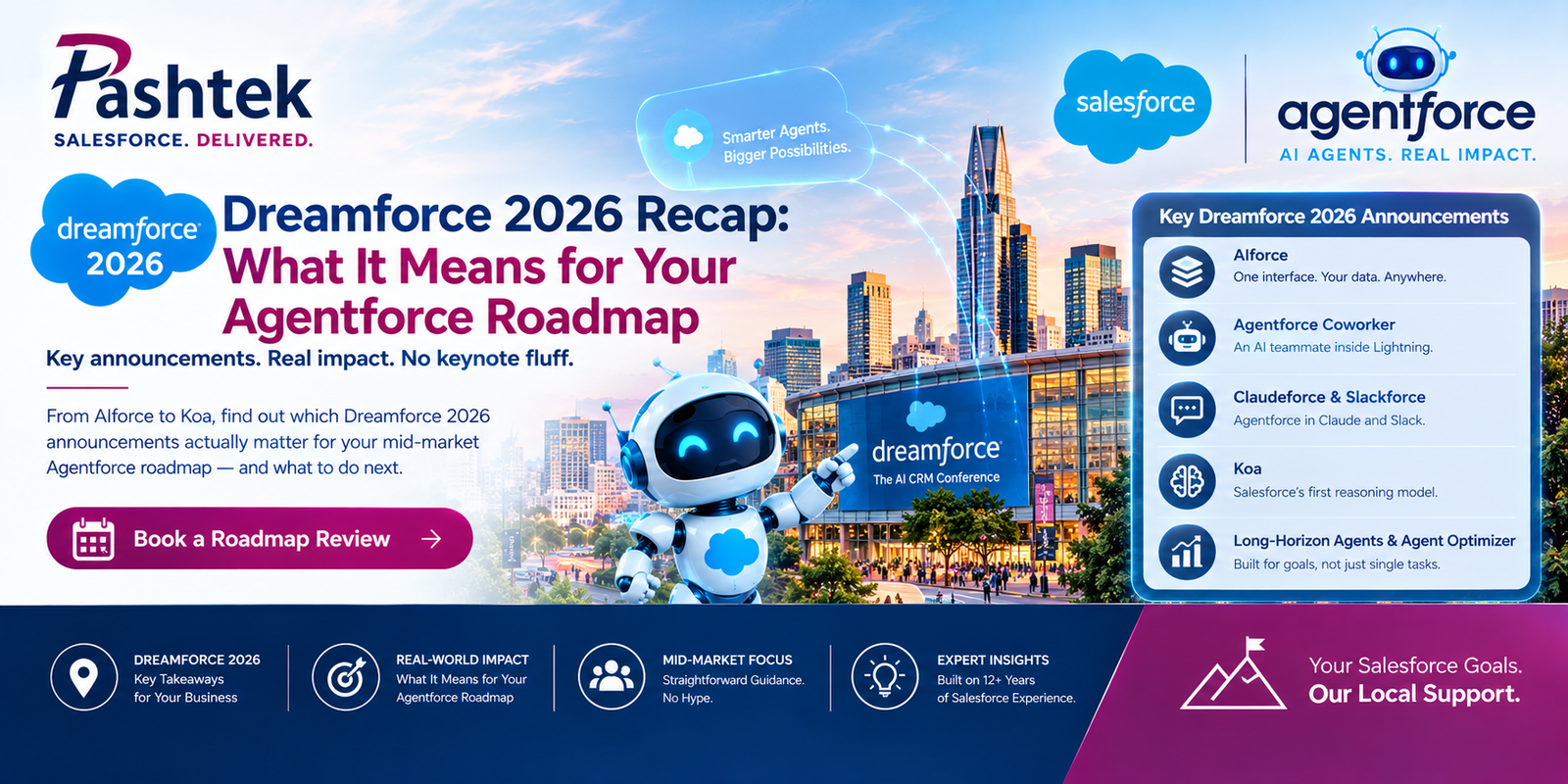
The central product reveal this year was AIforce, a new interface layer that sits above Data 360, Customer 360, and Agentforce, letting your data, workflows, and permissions get used from wherever your team already works, not just inside Salesforce’s own screens. Practically, this continues a shift Salesforce started at TDX in April with Headless 360, which exposed the platform’s capabilities as APIs, MCP tools, and CLI commands. The throughline across both: Salesforce is betting that agents and data need to reach users in Slack, in a browser, or in a third-party tool, not just inside the CRM.
Agentforce Coworker: an AI teammate inside Lightning
Agentforce Coworker is Salesforce’s autonomous AI teammate built directly into the platform, and adoption numbers shared at the keynote put 49,000 people already using it internally at Salesforce itself. Unlike a single-purpose agent scoped to one workflow, Coworker is positioned as a general-purpose assistant embedded in daily work, closer to how a human colleague would help across multiple tasks than a narrow case-deflection bot.
Claudeforce and Slackforce: Agentforce outside the CRM
Two announcements extend Agentforce beyond Salesforce’s own interface. Claudeforce moved into open beta at Dreamforce, bringing Salesforce context into Claude conversations. Slackforce Surfaces brings Salesforce data and visualizations directly into Slack conversations, so a rep or service agent doesn’t have to leave a Slack thread to see a customer record. Both reflect the same AIforce philosophy: agents should show up where people are already working.
Koa: Salesforce’s first reasoning model
Salesforce introduced Koa, its first CRM-specific reasoning model, built on NVIDIA Nemotron for agent reasoning, tool use, and decision-making. This matters for implementation work specifically, since a model purpose-built for CRM reasoning, rather than a general-purpose model repurposed for business tasks, should in principle make agents more reliable at the kind of multi-step, data-grounded reasoning a support or sales agent actually needs.
Long-horizon agents and Agent Optimizer
Long-horizon agents are a new category built to pursue a goal over days, weeks, or even months, rather than resolving a single conversation and stopping. Pairing with that, Agentforce Observability now includes an Optimizer that reads thousands of production sessions, finds recurring failure patterns, and ranks them by impact, essentially automating a chunk of the guardrail-tuning work we’ve always done manually for clients. We cover what this means for a live agent in more detail in our guide to Agentforce Hunter, since Hunter is one of the first named agents built around long-horizon behavior.
What wasn’t new: The Honest Caveat
This was a demo-heavy keynote, light on major surprises beyond the announcements above. If you were hoping for a dramatically different pricing model or a simplified path to production, that wasn’t the headline this year. The announcements extend and connect what Salesforce already had, rather than replacing it, which is arguably the more useful signal for a company already running Agentforce: your existing investment isn’t being leapfrogged, it’s being built on.
Pashtek tip: Not every Dreamforce announcement deserves a place on your roadmap this quarter. Ask us to walk through which of these, if any, actually change your specific project’s scope or timeline before you let a vendor keynote set your priorities.
What this means for a roadmap already in progress?
If you’re mid-implementation, nothing here should stop current work. AIforce and Headless 360 matter most if you’re planning to expose Agentforce capabilities to tools outside Salesforce; most mid-market deployments won’t touch that layer in year one. Agent Optimizer is worth asking about if you already have a live agent, since automated failure-pattern detection could meaningfully cut the manual review time in deployment phase 5 of our deployment guide. And if you’re evaluating a second or third agent, the long-horizon and orchestration direction Salesforce is pushing is worth understanding before you scope that expansion.
How Pashtek tracks Salesforce’s roadmap for clients?
Pashtek has built on Salesforce since 2012, and part of what that means in practice is filtering vendor announcements for what actually changes a client’s project, rather than reflexively recommending every new feature. We sent our team to Dreamforce 2026 specifically to separate the AIforce-level platform shift from the features most mid-market companies will actually touch this year, and we build that filtering into every Agentforce implementation we scope.
Book a roadmap review with Pashtek to sort the Dreamforce 2026 announcements that matter for your project from the ones that don’t, or email info@pashtek.com.
Frequently asked questions
Does AIforce replace Agentforce?
No. AIforce is an interface layer that sits above Agentforce, Data 360, and Customer 360, letting their capabilities reach users outside Salesforce’s own screens. Agentforce remains the agent product itself.
Is Koa available now, or still in preview?
Koa was introduced at Dreamforce 2026 as Salesforce’s first CRM reasoning model; check current release notes for your org’s specific availability, since rollout timing varies by edition and region.
Should a mid-market company care about Headless 360 and AIforce?
Mostly not yet. These matter most for companies planning to expose Salesforce data and agents to tools outside the platform. Most mid-market Agentforce projects in year one stay focused on a single, well-scoped in-platform agent.
What’s the single most practically useful Dreamforce 2026 announcement for a company already running Agentforce?
Agent Optimizer, for most existing deployments. Automated failure-pattern detection across production sessions directly supports the ongoing tuning work every live agent needs.