
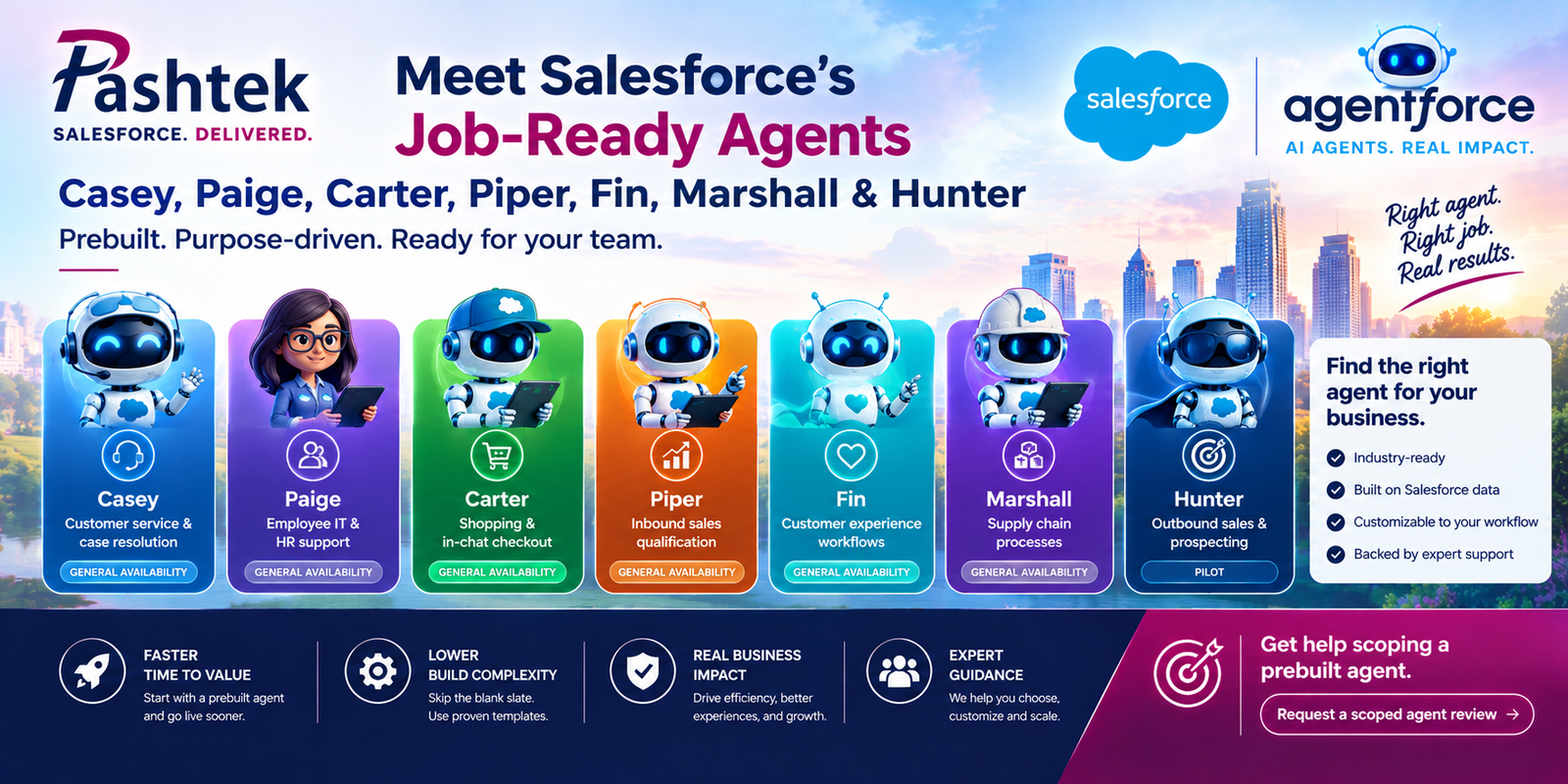
Meet Salesforce’s Job-Ready Agents: Casey, Paige, Carter, Piper, Fin, Marshall, and Hunter
Around Dreamforce 2026, Salesforce expanded the Agentforce portfolio with seven named, job-specific agents, each built for one function rather than assembled from scratch for every workflow. The shift in framing matters: instead of starting every project with a blank agent builder, these come with the relevant actions, data models, and business context already built in for a specific job. Pashtek has started fielding more client questions about which of these seven actually fits their team than about Agentforce in general, so here’s a plain-language breakdown of each one.
Casey: Customer Service and Case Resolution
Casey handles customer-service work across channels, voice, SMS, WhatsApp, and web chat, including returns and escalations. If your current Agentforce conversation has focused on Service Cloud case deflection, Casey is the closest prebuilt match to what you were likely already scoping, and it’s generally available now.
Paige: Employee IT and HR Support
Paige addresses employee IT and HR requests, functioning as an internal help desk agent rather than a customer-facing one. This overlaps with Agentforce IT Service, Salesforce’s broader push into internal support automation, and is worth evaluating together with that product if your interest is reducing internal ticket volume rather than customer case volume.
Carter: Shopping and In-Chat Checkout
Carter assists shoppers with product questions and in-chat checkout, aimed squarely at retail and e-commerce teams. For companies evaluating AI agents for order support or product guidance, Carter is a meaningfully different starting point than building a general customer-service agent, since checkout and product-catalog actions come pre-modeled.
Piper: Inbound Sales Qualification
Piper is built for inbound lead qualification, reviewing and scoring incoming leads against defined criteria before a rep ever picks up the phone. This is the agent most directly relevant to the lead-qualification use case we’ve recommended as a strong first pilot for sales teams evaluating Agentforce.
Fin: Customer-Experience Workflows
Fin addresses broader customer-experience workflows and is built in part on technology Salesforce acquired through a roughly $3.6 billion deal closed in early 2026. Fin’s scope sits closer to end-to-end customer journey support than Casey’s more case-specific focus, which makes the two worth comparing carefully if your use case touches both.
Marshall: Supply-Chain Processes
Marshall handles supply-chain workflows, a function with comparatively little existing Agentforce coverage before this release. For manufacturers and logistics companies, Marshall is a new, concrete entry point worth evaluating alongside the dealer-support and order-status use cases we’ve scoped for Midwest manufacturing clients.
Hunter: Outbound Sales and Prospecting
Hunter is the one agent on this list still in pilot, with general availability planned for November 2026. It’s built for outbound sales, prospecting, and follow-through, and uses Salesforce’s new long-horizon agent runtime to retain context and continue work across days or weeks rather than resolving a single session. We cover Hunter in more depth in our dedicated Hunter guide, since it’s early enough that most of the market hasn’t evaluated it yet.
Prebuilt agent or custom build: how to decide
A prebuilt agent gets you to a working pilot faster, since the topics, actions, and data model are already scoped for the job. The trade-off is flexibility: if your actual workflow diverges meaningfully from the standard job the agent was built for, you’ll spend time customizing anyway, sometimes more than starting from a clean build would have taken. Our general rule: if your use case maps closely to one of these seven jobs, start there and customize incrementally. If your workflow is genuinely unusual, a custom-scoped agent, following the same discovery process in our deployment guide, is still the better starting point.
Pashtek tip: Before committing to one of these seven, ask us to map your actual workflow against the agent’s built-in scope. We’ve seen teams assume Casey will handle something closer to Fin’s territory, which creates avoidable rework mid-pilot.
Data readiness still matters, prebuilt or not
None of these seven agents change the fundamental requirement that clean, current data makes an agent reliable. A prebuilt Casey deployment still needs accurate case history and a current knowledge base to answer correctly; a prebuilt Marshall still needs synced inventory and production data. Our Salesforce health check applies the same way regardless of whether you’re starting from a prebuilt agent or a custom one.
How Pashtek helps clients choose?
Pashtek maps each of these seven agents against a client’s actual workflow during discovery, rather than defaulting to whichever one sounds closest to their industry. We’ve found the gap between “sounds like a fit” and “actually is a fit” is often narrower or wider than clients expect, and getting that right before a build starts saves real rework later.
Frequently asked questions
Are all seven of Salesforce’s job-ready agents available now?
Six are generally available: Casey, Paige, Carter, Piper, Fin, and Marshall. Hunter remains in pilot with general availability planned for November 2026.
Can we customize a prebuilt agent like Casey or Piper?
Yes. These agents ship with a defined scope and data model as a starting point, but topics and actions can be extended or narrowed to fit your specific workflow during implementation.
Which prebuilt agent is the best first pilot for a company new to Agentforce?
It depends entirely on your highest-volume pain point. Casey for customer service, Piper for inbound sales qualification, and Paige for internal IT and HR support are the three most commonly scoped first pilots we see, since all three map to high-volume, well-documented workflows.
Does using a prebuilt agent mean we skip the discovery and data audit phase?
No. Data readiness and discovery matter just as much with a prebuilt agent as with a custom build. A prebuilt agent shortens the design phase, not the preparation work underneath it.
Get help scoping a prebuilt agent from Pashtek, or email info@pashtek.com.