
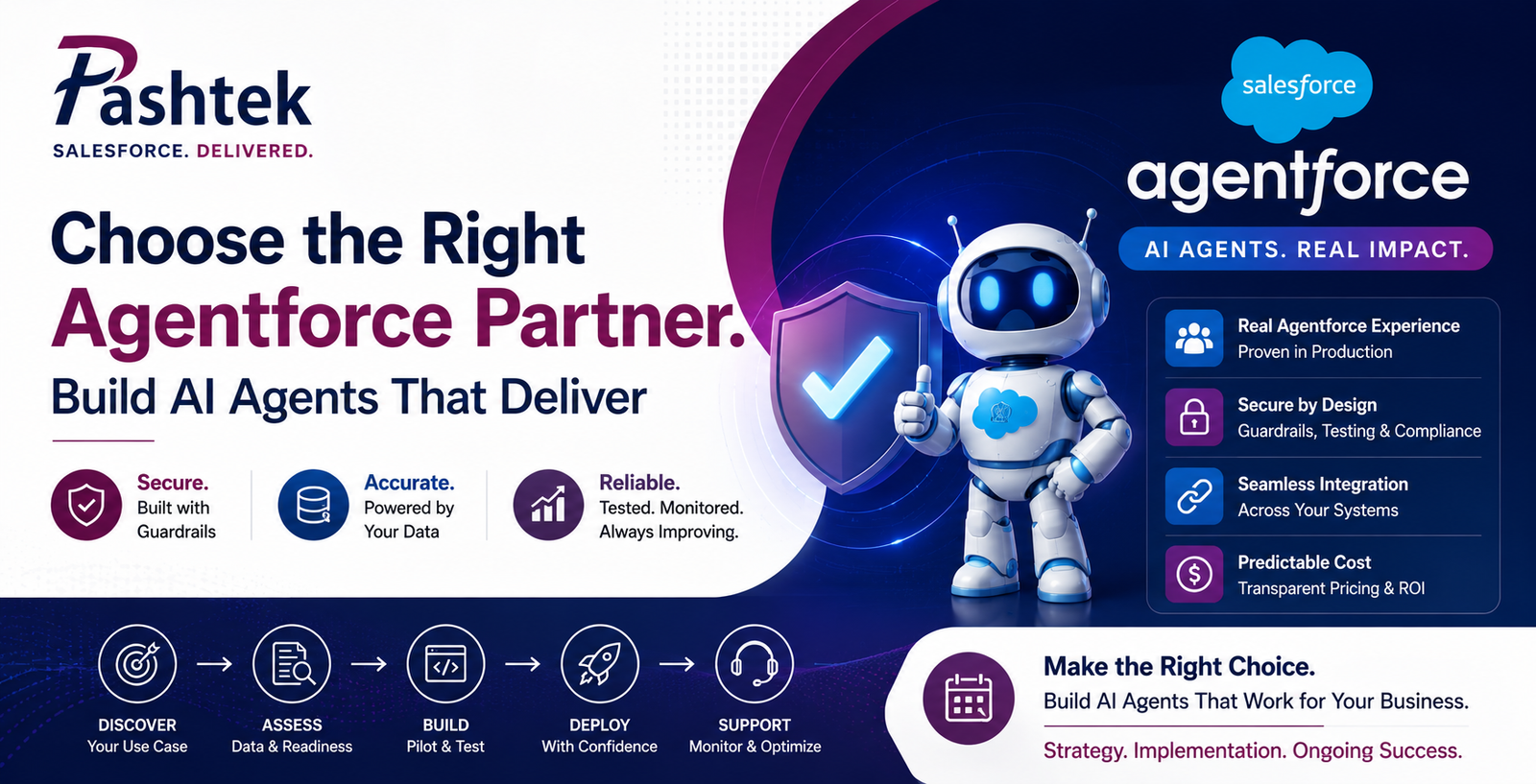
How to Choose an Agentforce Implementation Partner? A 2026 Buyer’s Checklist
Choosing the wrong Salesforce partner used to cost you a delayed project. At Pashtek, we’ve seen why choosing the right Agentforce partner matters even more. The wrong partner can cost you a customer-facing AI agent that gives wrong answers, exposes data it shouldn’t, or quietly runs up a bill nobody signed off on. From the outside the work looks like a normal Salesforce build. Underneath, it isn’t.
Why picking an Agentforce partner is different?
Plenty of firms are good at Salesforce configuration and custom development. Far fewer have taken an AI agent from a demo to live production, watched it handle real cases, and fixed it when it drifted. This is the approach Pashtek takes with Agentforce projects looking beyond configuration to data readiness, guardrails, integrations, testing, and long-term performance. Those are different skill sets, and the gap matters more than it looks.
Three things separate an Agentforce project from a standard Salesforce build.
1. The Agent Acts on Your Data
The agent reads records to answer questions and takes actions on your behalf. If your data is wrong or incomplete, the agent is confidently wrong in front of a customer. A partner who treats data quality as a footnote hands you that problem to discover later.
2. The Agent Needs Boundaries
Left open, an agent will try to answer things it shouldn’t or take actions it was never meant to. Someone has to define what it can touch, test it against edge cases, and watch it after launch. That is design work, not an afterthought.
3. The Cost Model Is New
Salesforce prices Agentforce partly by conversation, so a badly scoped rollout can cost far more than expected once volume climbs. A partner who can’t explain that model plainly can’t help you control it. Our breakdown of Agentforce pricing and implementation cost covers the details.
Keep those three things in mind as you read the checklist. Every item below traces back to one of them.
The Checklist: what to verify before you sign
1. Real Agentforce experience, not just Salesforce experience- Ask how many agents the firm has taken to production, in which clouds, and what those agents actually do. Ask to speak with a client running one today. If the answer drifts back to their general Salesforce history, you have your answer.
2. They audit your data before they build– A good partner insists on checking your org first and tells you plainly if it isn’t ready. If a firm is willing to start building agents on top of data they haven’t looked at, walk away. Our Salesforce health check exists for this reason, and the post on 12 signs your org isn’t ready for Agentforce lists what a real audit looks for.
3. Certified people on your actual team- Company partner badges tell you the firm has done Salesforce work. They don’t tell you who will sit on your project. Ask for the names and certifications of the people who will build your agents, including Agentforce-specific credentials, not just the account lead.
4. A written plan for guardrails and testing. Ask how the firm stops an agent from giving a wrong or unsafe answer, how they test it before launch, and how they monitor it afterward. A firm that has shipped agents answers this quickly and with specifics. Our Agentforce deployment guide shows what that plan should include.
5. Integration you can point to. Most useful agents need data that lives outside Salesforce: an ERP, a billing system, a data warehouse, an external API. Ask the firm to walk you through an integration they built and how the agent used that data. Vague answers here predict trouble later. Here is how we approach Salesforce integration.
6. Pricing and scope in plain terms. The firm should explain both Salesforce’s per-conversation cost and their own fees before quoting, and should scope the work first. A number offered before anyone has seen your org is a guess, and you pay for the guess later.
7. A support model after go-live. Agents drift as your processes and data change. Ask what happens after launch: who fixes the agent, how fast they respond, and what it costs. A firm that goes quiet on this question is selling you a project, not a working system. Our managed services cover the after.
8. References that match your situation. A healthcare provider, a bank, and a manufacturer each need different things from an agent. Ask for a reference in your industry or close to your size. General praise is easy to produce. A relevant reference is not.
Red flags that should end the conversation
- A fixed price before they have seen your org.
- Skipping or rushing the data audit.
- Not being able to name who will work on your project.
- Talking about features when you ask about outcomes.
- No answer for what happens after go-live.
- A guaranteed timeline offered on the first call.
Any one of these on its own is worth a hard question. Two or more together is usually a reason to keep looking.
Six questions for the first call
You can screen most firms in one conversation. Ask these and listen for specific answers:
- How many Agentforce agents have you put into production, and what do they do?
- Can I talk to a client running one now?
- What do you check in our org before you build anything?
- How do you keep an agent from giving a wrong answer, and how do you test for it?
- What does support look like after launch, and what does it cost?
- How will you price this, and what drives the number up or down?
Good partners welcome these questions, because the answers are where they win. A firm that gets defensive is telling you the answers are thin.
What a Sound Agentforce Implementation Process Looks Like?
The right sequence protects you. It usually runs like this:
Discovery → Salesforce Readiness Check → Pilot → Testing & Measurement → Production → Ongoing Support
A discovery session helps define the use case and business outcome. A readiness check evaluates your Salesforce data, configuration, integrations, and security. A focused pilot then allows the agent to be tested against a specific use case before expanding.
At Pashtek, this structured approach helps businesses validate an Agentforce use case before committing to a larger rollout.
The goal is not simply to launch an agent. It is to make sure the agent delivers a measurable business result while operating within clearly defined boundaries.
A partner who wants to skip straight to building across your whole org is optimizing for their invoice, not your result.
Where to Go From Here?
If you are vetting partners right now, Pashtek can help you evaluate whether Agentforce is the right fit for your business and whether your Salesforce org is ready for implementation.
Book a free consultation and we will walk through your use case, tell you honestly whether your org is ready, and scope the work before we put a number on it.
If you would rather read first, start with what Agentforce costs and how to build the ROI case, so you walk into every partner call knowing your own numbers.
Frequently Asked Questions
What is an Agentforce implementation partner?
A firm that designs, builds, tests, and supports Salesforce Agentforce agents for your business, including the data and integration work the agents depend on.
How much does it cost to hire one?
It depends on the use case and the state of your data. Salesforce charges partly per conversation, and the partner charges for the build and support. Our Agentforce implementation cost guide gives real ranges.
Do I need a partner, or can my admin do it?
A strong admin can run a small pilot. Production agents that touch customers, outside systems, and sensitive data usually need people who have shipped them before, mostly because of the guardrail, testing, and integration work.
How long does an Agentforce project take?
A focused pilot can run in a few weeks. A production rollout across several use cases takes longer and depends heavily on how clean your data is going in. Start with a health check to find out.