
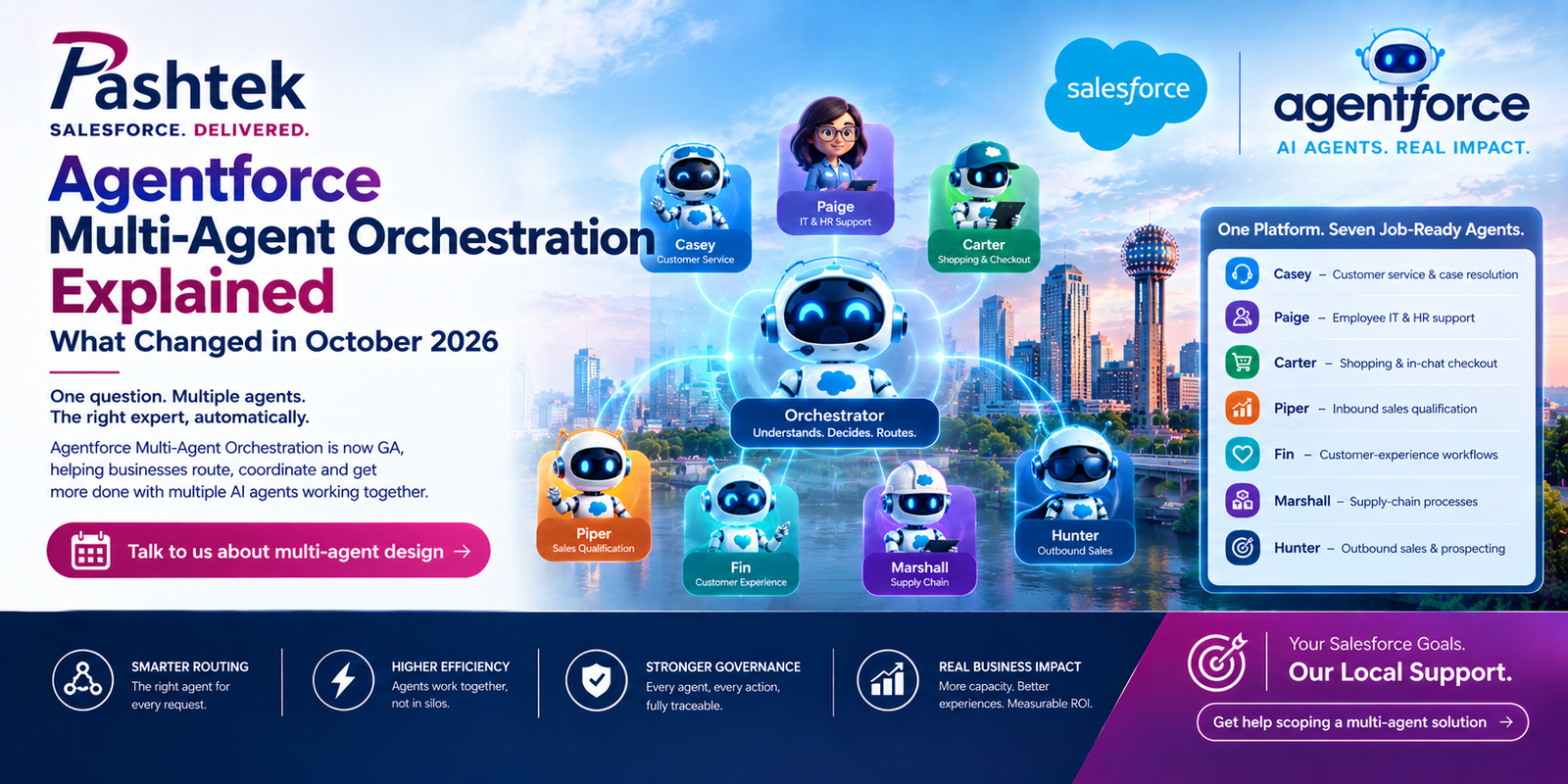
Agentforce Multi-Agent Orchestration Explained: What Changed in October 2026
Agentforce Multi-Agent Orchestration reached general availability on June 15, 2026, as the headline feature of Salesforce’s Summer ’26 release, and Dreamforce 2026 in September built directly on top of it with Agentforce Coworker, long-horizon agents, and third-party orchestration support. By October, orchestration has moved from a new GA feature most companies were still evaluating to one a meaningful share of Pashtek’s existing Agentforce clients are actively asking about as they look at a second or third agent. Here’s what it actually does, and when it’s worth the added complexity.
What Multi-Agent Orchestration Actually Is?
Before orchestration, every Agentforce deployment treated each agent as a self-contained worker handling its own conversations independently. Orchestration introduces a primary agent, sometimes called the orchestrator, as a single, intelligent entry point for user interactions. Salesforce’s Atlas Reasoning Engine routes each incoming query to the right specialist agent based on that agent’s description and available actions, rather than requiring the user to know which specific agent to talk to.
In practice, this means a customer or employee can ask one question in one place, and the orchestrator decides whether a billing specialist agent, a shipping specialist agent, or a general support agent should handle it, potentially pulling in more than one along the way.
Why this matters for cost and complexity, not just capability?
One of the most practically important changes with orchestration is unit economics. A single customer interaction that used to invoke one agent and three to five actions can now invoke five or six agents and fifteen to thirty actions once orchestration is in play. If you’re on the Flex Credit pricing model covered in our Agentforce pricing guide, this directly changes your expected monthly cost, and it’s worth modeling before you adopt orchestration, not after your first invoice.
When orchestration is worth adding?
Orchestration earns its complexity when you already have, or plan to build, more than one specialized agent and your users shouldn’t have to know which one to talk to. A company running a billing agent and a shipping agent separately, where customers currently have to guess which one to contact, is a clean orchestration use case: one entry point, two specialists routed automatically behind it.
It’s a weaker fit for a company with a single, well-scoped agent and no near-term plan to add a second. The added architectural complexity, more identities to manage, more authorization boundaries, more audit events, isn’t worth taking on until you actually need multiple specialists working together.
What orchestration changes about security and governance?
Every agent in an orchestrated system is its own identity, every handoff between agents is an authorization boundary, and every action is an audit event. Without deliberate lifecycle governance, provisioning new agents, rotating credentials, revoking access when an agent is retired, a compromised or misconfigured agent can cascade its effect across the whole orchestrated system rather than staying contained to one workflow. This is a meaningfully bigger governance surface than a single-agent deployment, and it should be scoped explicitly in your guardrail design before you add a second agent, not treated as an afterthought once orchestration is live.
A realistic path to adopting orchestration
If you already have one well-performing Agentforce agent in production, the typical path is identifying a second, genuinely distinct use case, say, a billing specialist alongside your existing support agent, rather than splitting one agent’s existing scope into two for its own sake. Build and test the second agent largely as you would a standalone agent, then layer the orchestrator on top once both specialists are independently reliable. Our deployment guide covers this phased approach in more detail, and the same discovery-first discipline applies whether you’re launching your first agent or your third.
Pashtek tip: Before adopting orchestration, ask us to model your expected action volume under the new unit economics. Companies moving from a single agent to an orchestrated pair are sometimes surprised by how much their monthly Flex Credit spend increases, and it’s a much easier conversation to have before launch than after.
Is orchestration right for your next phase?
Industry-wide, by 2027 roughly a third of agentic AI implementations are expected to combine agents with different skills to handle complex tasks, which suggests orchestration is a genuine direction rather than a passing feature. That doesn’t mean every company needs it in year one. If your current single agent still has headroom, in scope, in deflection rate, in topics it could reasonably cover, expanding that agent’s scope is often simpler and cheaper than standing up a second one and orchestrating between them.
How Pashtek approaches multi-agent design
Pashtek scopes orchestration against a client’s actual roadmap, not against the feature’s novelty. We model the cost implications before recommending a second agent, and we build the identity, authorization, and audit governance into the design from the start, consistent with the discipline we’ve applied to every Agentforce implementation since the product launched.
Frequently asked questions
Do we need Multi-Agent Orchestration to run more than one Agentforce agent?
Not strictly. You can run multiple independent agents without orchestration, but users then need to know which agent to approach for which question. Orchestration adds the single entry point and automatic routing.
How does orchestration affect our Agentforce billing?
A single interaction can now invoke multiple agents and significantly more actions than before, which matters most if you’re on Flex Credit pricing. Model this against your expected usage before adopting orchestration.
Is orchestration available on all Agentforce pricing and license tiers?
Availability can vary by edition and license; confirm current eligibility for your specific org with your Salesforce account team or your implementation partner before planning a build.
What’s the biggest risk in adopting Multi-Agent Orchestration too early?
Taking on the added governance and cost complexity before you actually have a second genuinely distinct use case. Expanding one agent’s scope is often simpler than orchestrating between two if you don’t yet need true specialization.
Talk to us about multi-agent design at Pashtek, or email info@pashtek.com.