Salesforce Implementation Cost 2026: Budget by Company Size
Salesforce implementation cost depends mostly on how many processes, integrations and data sources you bring over, not on the license you pick. Pashtek, a Salesforce consulting partner in Chandler, Arizona, scopes implementations as fixed-price projects, and this guide shows US buyers how to budget one.
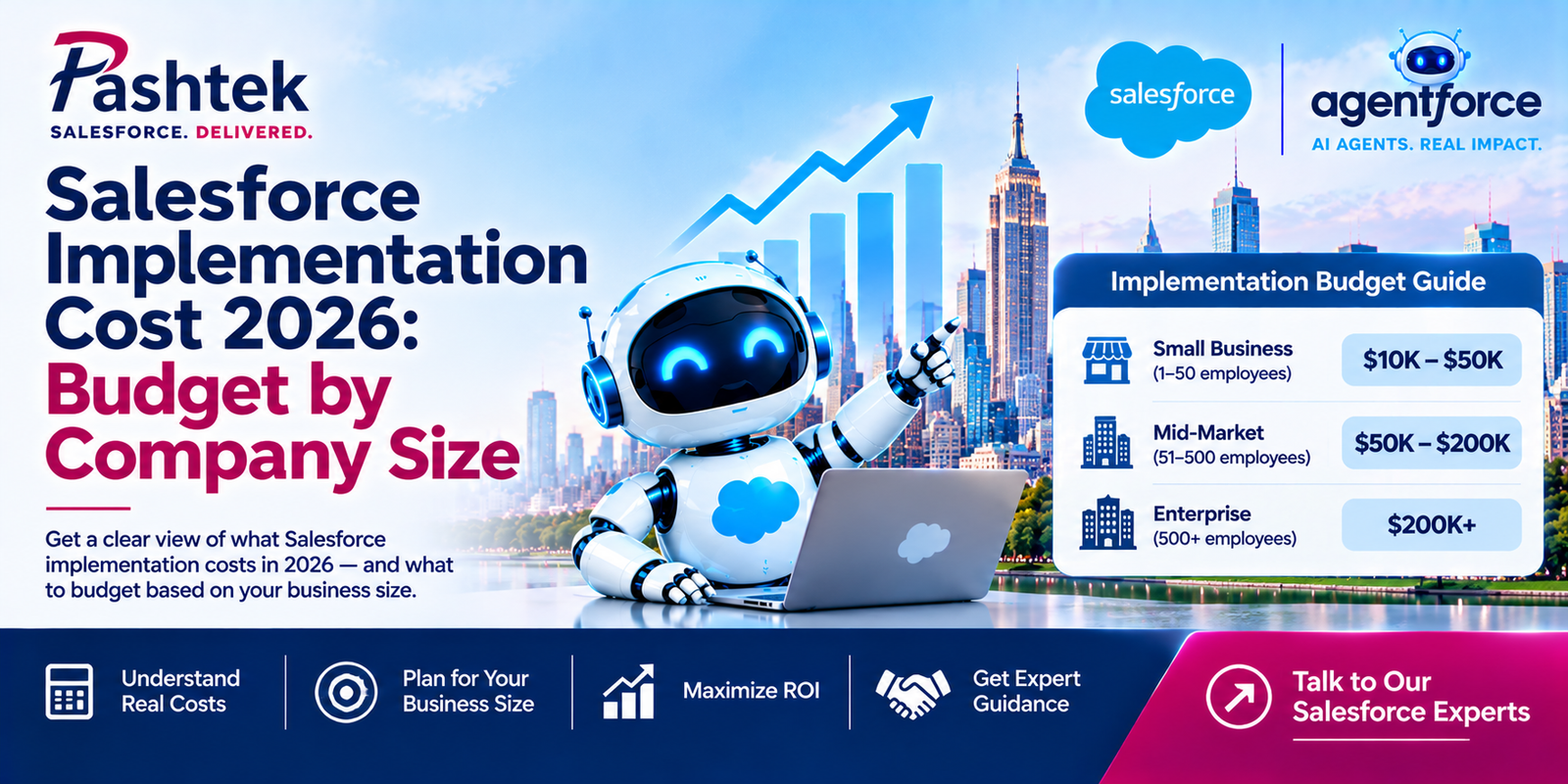
The short answer: in services alone, a small-business implementation typically runs $10,000 to $30,000, a mid-market project $40,000 to $150,000, and an enterprise rollout $150,000 to $500,000 or more. Those ranges come from a vendor guide, so they orient you. They do not replace a proposal for your scope. License fees are billed separately.
How much does a Salesforce implementation cost?
Codleo’s October 2026 guide, which cites more than 275 Salesforce engagements, gives these services-only ranges. They exclude licenses.
| Company size | Users | Typical services cost | Typical timeline |
|---|---|---|---|
| Small business | 1 to 50 | $10,000 to $30,000 | 6 to 10 weeks |
| Mid-market | 51 to 500 | $40,000 to $150,000 | 14 to 24 weeks |
| Enterprise | 500+ | $150,000 to $500,000+ | 6 to 12+ months |
| Multi-cloud or global rollout | Varies | $500,000+ | 12+ months, phased |
Source: Codleo, Salesforce implementation cost (published October 1, 2026). Codleo does not explain how it derived the ranges, and its own FAQ gives different figures for small and mid-sized businesses.
A second vendor, Stand8, puts a standard mid-sized implementation at $30,000 to $60,000 and a complex multi-cloud or compliance-heavy one at $150,000 or more. The two sources overlap, but they are not the same number, which is the point. “Mid-market” covers a $45,000 Sales Cloud project and a $140,000 build with CPQ, three integrations and a data migration. Scope decides the price, and size only correlates with scope.
What each tier usually includes?
These scope descriptions are illustrative. They show what tends to sit behind each range, not a quote.
- Small team: standard Sales Cloud objects, one pipeline, one data import, a handful of reports, light automation.
- Mid-market: custom objects, several teams on different processes, two to four integrations, quoting or service workflows, role-based security, a phased go-live.
- Enterprise: multiple clouds, complex data models, many integrations, strict compliance requirements, change management across regions.
What drives Salesforce implementation cost
Seven factors move the total. The first three do most of the damage when they are underestimated.
Integrations
Every system that has to share data with Salesforce adds design, build, testing and support. Stand8 lists integrations at $10,000 to $100,000 or more depending on the number of systems, real-time versus batch sync, middleware and compliance. Connecting an ERP such as SAP is a different job from connecting a marketing tool. Pashtek delivers MuleSoft and SAP integrations, and the integration list is the first thing it asks for.
Data migration
Clean data moves quickly. Duplicated, inconsistent data does not. The cost is in profiling, deduplication, mapping and the test loads, not in the final import. A quote that has no migration line is a quote that will grow later.
Customization versus configuration
Configuring standard Salesforce features is cheaper and easier to maintain than writing code. Codleo puts configuration and customization at 35 to 45 percent of an implementation budget, and Stand8 puts customization at 20 to 40 percent. Custom Apex and Lightning Web Components development is sometimes the right call, but each custom component is something your team owns after go-live.
Number of clouds and processes
Sales Cloud, Service Cloud, CPQ, Marketing Cloud and industry clouds each bring their own data model and users. Adding CPQ or Manufacturing Cloud to a Sales Cloud project changes the scope more than adding 20 users does.
Compliance and security
Regulated industries add review cycles, field-level security design, audit trails and sometimes separate environments. Healthcare, financial services and government work should be quoted with those requirements stated up front.
Who delivers the work?
Hourly rates differ by provider. Codleo reports $50 to $150 per hour for freelancers and $100 to $250 for certified US partners, with large systems integrators higher. A lower rate does not always mean a lower total, because junior teams usually need more hours and more rework. Rates by role are covered in Pashtek’s guide to Salesforce consulting rates.
Timeline pressure
Faster delivery generally costs more because it needs a larger team in parallel. Stand8 notes the same premium. If the go-live date is flexible, a phased plan lowers risk and lets you fund phase two from what phase one proves.
Planning a project and not sure what to include? Pashtek’s team can review your scope in a free 30-minute call. Book a time.
Fixed price or time and materials?
The pricing model changes who carries the risk, so it matters as much as the rate.
| Model | How it works | Fits best when | Watch for |
|---|---|---|---|
| Fixed price | Scope and fee agreed up front. Stand8 reports 30 to 50 percent due at signing, the rest at milestones. | Processes, data sources and integrations are known | Change orders when scope moves, and deliverables described too loosely to dispute |
| Time and materials | You pay for hours worked, ideally under a cap | Scope is still being discovered | A total that grows with no stopping point |
| Hybrid | Fixed fee for discovery and phase one, time and materials or a new fixed fee for later phases | Larger programs delivered in stages | A clear decision point between phases |
| Retainer | Monthly fee for support and enhancements after go-live | The system is live and needs steady care | Hours that expire unused, and unclear response times |
Pashtek works on fixed-price terms for implementations. The sequence is a discovery workshop first, then a written proposal that Pashtek says takes about five business days. The workshop is where hidden costs surface, which is why it comes before the number.
How long does a Salesforce implementation take?
Codleo’s ranges are roughly 6 to 10 weeks for a small business, 14 to 24 weeks for mid-market, and 6 to 12 months or more for enterprise. The calendar time depends less on build effort than on how fast your team answers questions, signs off on designs and cleans data. Most delays come from waiting on decisions, not from development.
A typical engagement moves through discovery and design, configuration and build, data migration, user acceptance testing, go-live and a hypercare period when the team fixes what real use exposes. If a proposal skips discovery or hypercare, ask why.
Costs that arrive after go-live
The project invoice is not the last one.
- Hypercare: Stand8 lists $10,000 to $45,000 for one to three months of post-launch support, while Codleo puts it at 3 to 5 percent of the project budget. Ask whether it is inside your fixed price or billed separately.
- Training: Stand8 lists $2,000 to $20,000, depending on how many users and roles need it.
- Administration and support: Codleo shows $30,000 to $60,000 a year for a mid-market org, and $3,000 to $10,000 for a small one. Pashtek’s managed services run month-to-month for teams that want admin and development help without a full-time hire.
- Enhancements: Codleo estimates $10,000 to $20,000 a year for mid-market teams from year two.
A year-one budget for a 40-user team
Here is how the pieces add up for a mid-market company with 40 users on Salesforce Core. Licenses use Salesforce’s published $195 per user per month, which you can check in the 2026 pricing guide. Services and support use Codleo’s mid-market ranges.
| Line | Low | High |
|---|---|---|
| Licenses (40 users x $195 x 12) | $93,600 | $93,600 |
| Implementation services | $40,000 | $150,000 |
| First-year admin and support | $30,000 | $60,000 |
| Year-one total | $163,600 | $303,600 |
In this example licenses are between 31 and 57 percent of the first-year bill. That is why a budget built from the price list alone comes in far too low. Treat the services figures as a starting range from a vendor guide, and replace them with a fixed-price proposal as soon as you have one.
How to get a fixed-price quote that holds?
A partner can only fix a price on what it can see. Bring this to the first conversation.
- Users by role, and which of them need full licenses
- The processes you want in Salesforce, in order of priority, with owners
- Systems that must connect, and whether each sync is real-time or batch
- Data sources, rough record counts and your honest view of data quality
- Reports and dashboards leadership needs on day one
- Compliance or security requirements
- Target go-live date, and what is fixed about it
Red flags in an implementation proposal
- No line for data migration or integrations
- “Customization” described in hours with no deliverables
- No discovery phase before a fixed number
- No acceptance criteria for user testing
- No hypercare, or hypercare buried in an exclusions list
- A price far below every other bid, with no explanation of what the others include
The guide to choosing a Salesforce implementation partner has a longer list of questions to put to each bidder.
Frequently asked questions
How much does a Salesforce implementation cost?
In services alone, Codleo reports $10,000 to $30,000 for small businesses, $40,000 to $150,000 for mid-market companies and $150,000 to $500,000 or more for enterprises. Another vendor, Stand8, reports $30,000 to $60,000 for a standard mid-sized project. Licenses, add-ons and ongoing support are on top.
Is implementation cost separate from Salesforce license fees?
Yes. Salesforce bills licenses by user. An implementation partner bills services for design, configuration, data migration, integration, testing and training. Both appear in a year-one budget.
How long does it take to implement Salesforce?
Small teams commonly take 6 to 10 weeks, and mid-market projects 14 to 24 weeks, based on Codleo’s ranges. Integrations, data quality and how quickly your team makes decisions move those numbers more than the number of users does.
Why do Salesforce implementation quotes vary so much?
They describe different scopes. One quote may include data migration, integrations and training, and another may leave them for change orders. Compare line by line, not by total.
Should I choose fixed price or time and materials?
Choose fixed price once your processes, data and integrations are defined, and a capped time-and-materials discovery phase if they are not. Many teams combine the two.
What does Pashtek need to quote a Salesforce implementation?
Users by role, priority processes, systems to integrate, data sources and volumes, compliance needs and a target date. Pashtek runs a discovery workshop to confirm these, then provides a fixed-price proposal. Start with a free 30-minute consultation.
What industries does Pashtek implement Salesforce for?
Pashtek’s site lists manufacturing, distribution, SaaS and technology, semiconductor, healthcare, financial services, nonprofit and utilities, with Salesforce work across more than a dozen clouds.
Get a fixed-price Salesforce estimate
A range is useful for a first budget conversation. A fixed price is what lets you sign. Pashtek is a Salesforce consulting partner in Chandler, Arizona, serving US mid-market and enterprise teams.
Book a free 30-minute consultation to talk through scope, or contact Pashtek with your user count, systems and target go-live date. You can also read about the Salesforce implementation service first.