
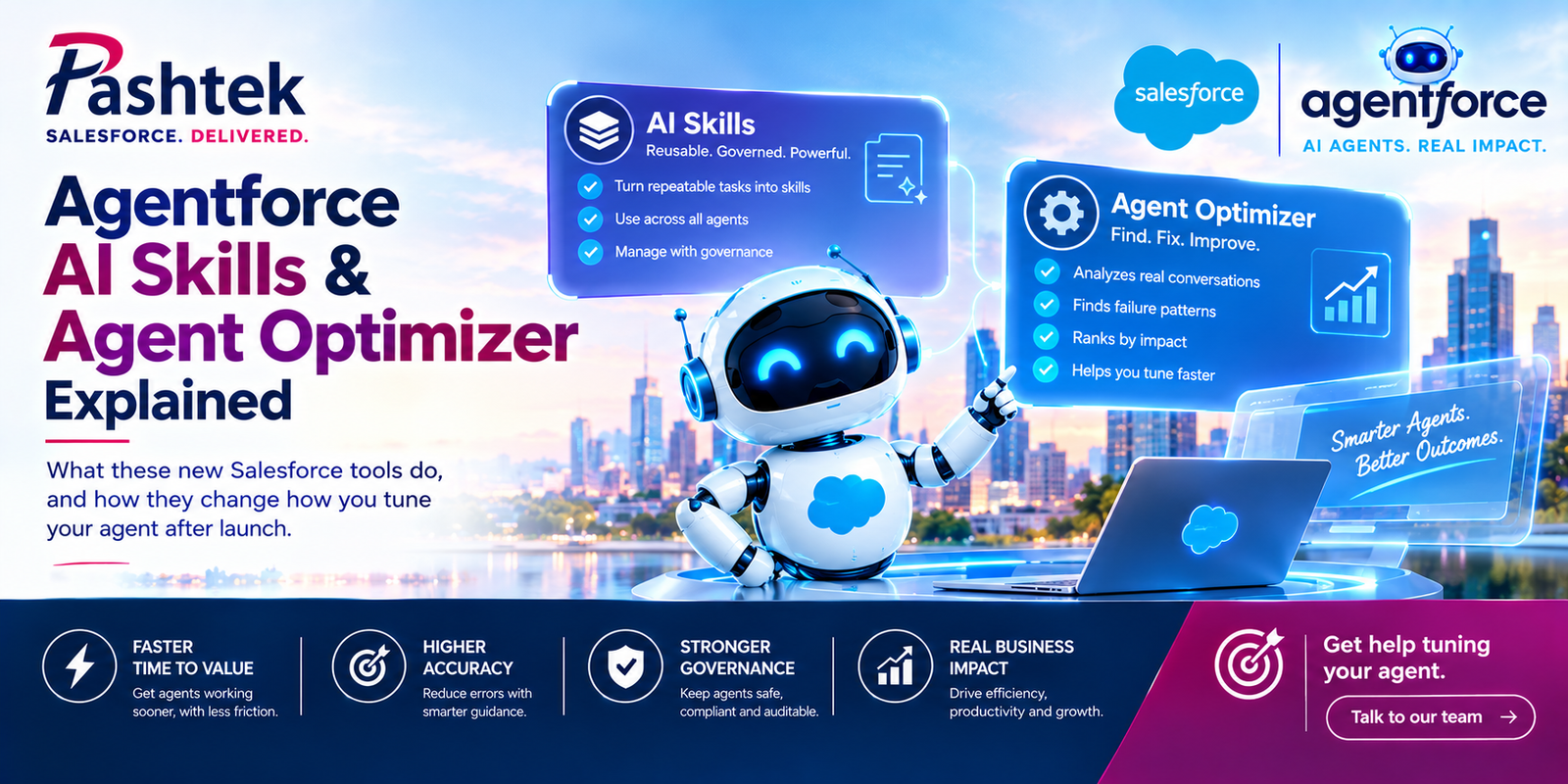
AI Skills & Agent Optimizer: Salesforce’s New Agentforce Tools Explained
Agentforce Agent Optimizer is an agent that builds and refines your other agents, and AI Skills are reusable, governed instructions that any agent can run. Both were highlighted at Dreamforce 2026, and Salesforce’s September announcement put general availability for both in October 2026, so they are landing in customer orgs right about now. Pashtek has spent years doing the manual version of this work for clients: reading transcripts, finding the failure patterns, and tightening the agent. Here is what these two features actually do, and what they do not replace.
What Agent Optimizer does?
Salesforce describes Agent Optimizer as working across the whole agent lifecycle, and it shows up in two places.
In Agentforce Builder, you describe what you want the agent to do in plain language. Optimizer then creates subagents, stubs out the actions, and tests as it builds. That shortens the blank-page problem on a new agent.
In Agentforce Observability, Optimizer reads thousands of production sessions, finds recurring failure patterns, and ranks them by impact. In practice, that means a list of “here are the five ways your agent fails most often, ordered by how many conversations each one touches.”
Agentforce already had observability and an earlier Optimization tool inside Studio that tagged conversations and broke sessions into moments. Agent Optimizer sits on top of that foundation and adds the part that used to be human work: deciding what to fix first.
What AI Skills do?
AI Skills turn repeatable work into reusable, governed instructions that any agent can run. Inside Agentforce Coworker, an employee can teach the assistant how to complete a task once, then reuse that method across the workforce and across interfaces. Salesforce manages skills in Agentforce Studio, with coding skills for developers and business skills for admins and end users.
The practical value is consistency. Without skills, the same task gets re-explained in slightly different words in every prompt, and the agent’s behavior drifts. A skill pins down the procedure once, and governance controls decide who can create, edit, and run it.
Two features, two different jobs
| AI Skills | Agent Optimizer | |
|---|---|---|
| What it is | Reusable, governed task instructions | An agent that builds and refines agents |
| Who benefits first | Employees using Agentforce Coworker, admins managing skills | Admins and builders running live agents |
| Main payoff | Consistent task execution across agents | Faster diagnosis and tuning of agent failures |
| Salesforce’s stated timing | Pilot, GA planned October 2026 | GA planned October 2026 |
Timing is the part to verify. These dates come from Salesforce’s September announcements, and availability can vary by edition and region, so confirm the status in your own org’s release notes before you plan around either feature.
What Optimizer does not replace?
A ranked list of failure patterns is a diagnosis, not a fix. Someone still has to decide whether a failure comes from a missing knowledge article, a badly scoped topic, a stale data field, or a confidence threshold set too loose. Those are judgment calls, and the wrong fix can make the agent worse on the questions it used to handle well.
Optimizer also works on the sessions your agent has already had. If the agent has not seen enough real traffic, there is not much to learn from. That is one more reason to start with a narrow pilot and a real production window, as laid out in our Agentforce deployment guide.
And it does not clean your data. If the same customer exists as three records, Optimizer can tell you the agent keeps citing the wrong history, but the repair is a data project. Our Salesforce health check covers the readiness problems that show up as agent failures later.
How to use both well?
Use Optimizer’s ranked failures as the agenda for a recurring tuning review, not as an automatic fix button. A monthly review where an admin, a business owner, and someone who reads real transcripts agree on the top three fixes works better than letting changes pile up unreviewed.
Use AI Skills for tasks that are truly repeatable and low-ambiguity, such as a standard refund check or a standard account lookup procedure. Skip them for judgment-heavy work, where a frozen procedure can mislead the agent.
Keep a change log. When Optimizer helps rewrite a subagent or action, record what changed and why, so that a bad week after a change is traceable. This pairs with the guardrail habits in our Agentforce best practices guide.
Pashtek tip: If you already have a live agent, ask us for a one-time tuning assessment before you switch Optimizer on. We review a sample of your sessions by hand first, so you know what a good diagnosis looks like and can judge whether Optimizer’s ranking matches reality.
How Pashtek helps with agent tuning?
Pashtek has built on Salesforce since 2012 from our Chandler, Arizona base, and tuning is a standard part of how we run an Agentforce implementation. We review production sessions, rank failure patterns, fix the root cause in data, knowledge, or scope, and then re-test. These new tools make the first two steps faster. We use them where they help and check their output against real transcripts before anything changes in production.
Frequently asked questions
Is Agent Optimizer generally available now?
Salesforce planned general availability for October 2026. Check your org’s release notes for current status, since rollout can vary by edition and region.
Do AI Skills only work inside Agentforce Coworker?
Salesforce’s announcement introduced AI Skills inside Agentforce Coworker and described them as instructions any agent can run, managed in Agentforce Studio. Confirm the exact scope available in your edition before planning a build around them.
Can Agent Optimizer fix my agent automatically?
It diagnoses and helps refine, but a person should review and approve changes. The cause of a failure is often data or scope, which needs a human decision.
Why should we choose Pashtek to help tune our Agentforce agent?
Pashtek combines Salesforce experience dating to 2012 with a hands-on review of real sessions, then fixes the underlying data, knowledge, or scope issue rather than only adjusting prompts.
Get help tuning your agent from Pashtek, or email info@pashtek.com.