
Is Agentforce Actually Driving ROI? What the Data Really Shows
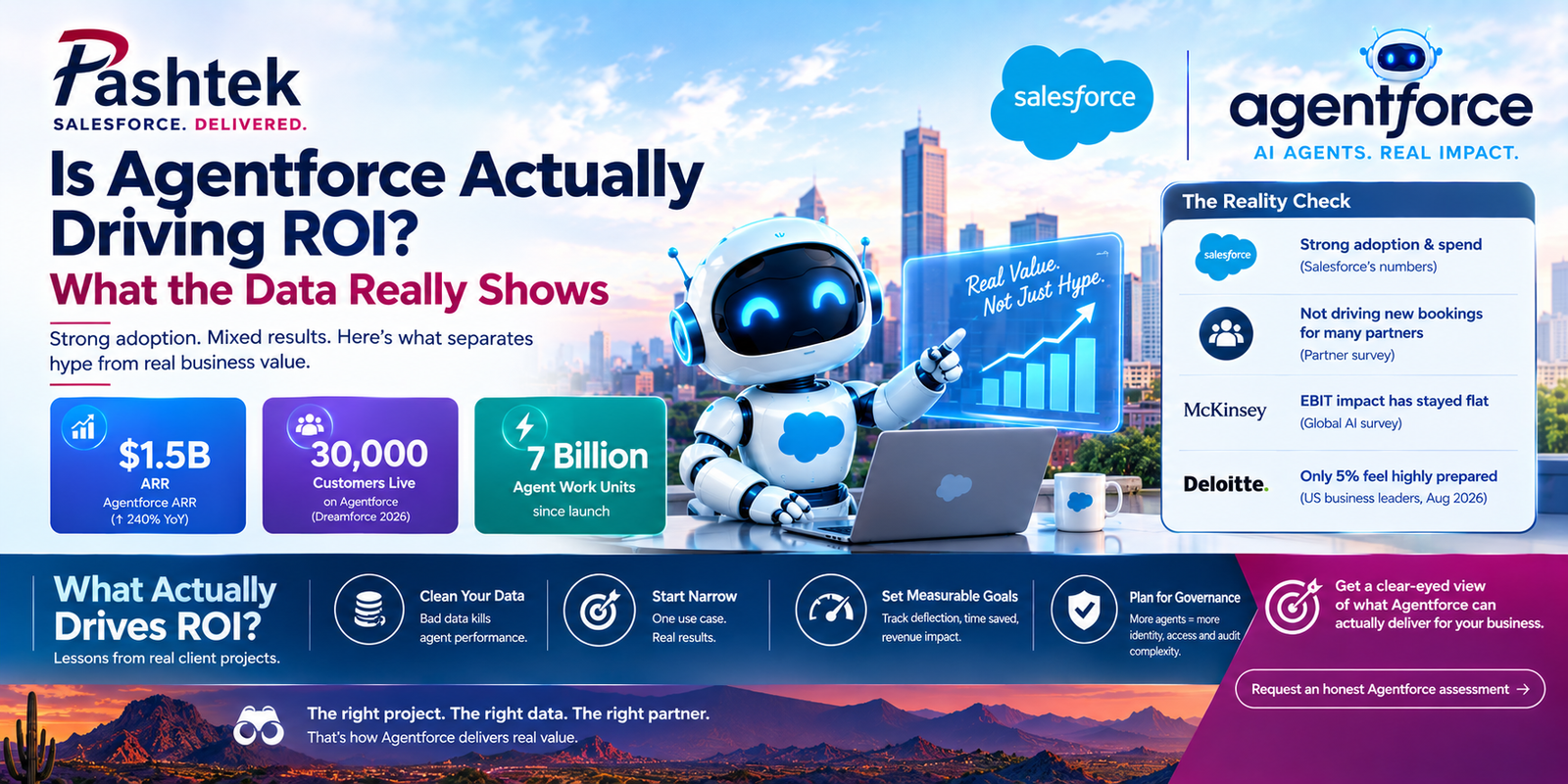
Two things are true about Agentforce at once, and most content online picks one and ignores the other. Salesforce’s own numbers are genuinely strong: Agentforce ARR crossed $1.5 billion, up roughly 240 percent year over year, with 30,000 customers live on the platform as of Dreamforce 2026. At the same time, a sell-side survey of Salesforce partners reportedly found Agentforce isn’t driving new bookings for a meaningful share of them, and McKinsey’s global AI survey found the share of companies attributing measurable EBIT impact to AI has stayed flat year over year. A Deloitte survey of 501 US business leaders in August 2026 found only 5 percent consider their business processes highly prepared for AI agents. Pashtek has implemented Agentforce since it launched, and here’s an honest read on what separates a project that pays off from one that doesn’t.
Why both sets of numbers are correct at once?
Salesforce’s growth figures measure adoption and spend, how many customers are buying and how much. They don’t measure whether those customers are getting proportional business value back. The partner and McKinsey data measure something different: whether the spend is translating into bookings, cost reduction, or profit impact that shows up in the numbers that actually matter to a CFO. A company can be a genuine Agentforce customer, counted fully in Salesforce’s growth figures, while still getting disappointing results if the project wasn’t scoped or executed well. Adoption and impact are not the same metric, and conflating them is how both the hype and the skepticism end up overstated.
Worth noting too: Salesforce’s ARR definition has widened over time, a recent quarterly release explicitly stated that Agentforce ARR now includes additional AI offerings beyond the original product, which means growth percentages aren’t always a clean year-over-year comparison. That doesn’t make the growth fake, but it does mean the headline percentage deserves a second look before you benchmark your own results against it.
What separates a project that delivers ROI from one that doesn’t?
In our own client work, the pattern is consistent enough to be worth stating plainly. Projects that deliver measurable ROI almost always did a real data audit before building, scoped a single, narrow use case for the first pilot, and defined specific success metrics upfront rather than measuring success as “we launched an agent.” Projects that disappoint tend to share the opposite pattern: dirty data no one addressed, an ambitious multi-topic scope for a first launch, and vague goals that made it impossible to tell whether the agent was actually working.
The Deloitte finding that only 5 percent of companies feel highly prepared for AI agents lines up with what we see directly: readiness, not the underlying technology, is usually the gap. Our Salesforce health check exists specifically because this is the single most common reason a pilot underperforms.
How to read a vendor ROI claim skeptically?
When you see a case study claiming dramatic deflection or productivity numbers, ask three questions before taking it at face value: what was the starting data quality, how narrow was the initial scope, and over what time period was the result measured. A 60 percent deflection rate achieved after six months of tuning on a narrowly scoped, well-documented use case is a very different claim than the same number implied as a day-one result. Our own ROI modeling guide walks through building a conservative, defensible first-year estimate using your own numbers rather than a vendor’s best-case example.
What this means for your own decision?
The honest answer to “does Agentforce work” is: it works when the underlying conditions are right, and it disappoints when they aren’t, which is a less exciting answer than either the hype or the backlash, but it’s the accurate one. Before committing budget, get a clear-eyed read on your own data readiness, scope a genuinely narrow first use case, and set measurable success criteria you’ll actually check against. None of that is specific to Agentforce, it’s the same discipline that separates successful automation projects from disappointing ones in any era of enterprise software.
Pashtek tip: Ask any partner pitching you an Agentforce project, including us, to show real before-and-after metrics from a comparable client, not a vendor case study. If they can’t produce specifics, that’s a signal worth taking seriously.
How Pashtek approaches Agentforce ROI honestly?
Pashtek doesn’t default to recommending Agentforce for every client conversation, and we won’t tell you a project will succeed if your data and scope aren’t ready for it. We build conservative, defensible ROI models from your own numbers, recommend the health check before the build when your data suggests it’s needed, and we’ve turned down scope that we didn’t think would deliver results as proposed. That discipline is part of why our clients’ numbers tend to hold up under real scrutiny.
Frequently asked questions
Is Agentforce’s reported growth real, or is it inflated by broadened definitions?
The underlying customer and usage growth appears genuine, but Salesforce has widened what counts toward Agentforce ARR over time, which means headline growth percentages aren’t always a clean apples-to-apples comparison year over year.
Why do some Salesforce partners report Agentforce isn’t driving bookings?
This likely reflects a mix of factors: some partners may be newer to Agentforce implementation specifically, and some clients’ projects may be underperforming due to readiness gaps rather than the technology itself being ineffective.
What’s the single best predictor of whether an Agentforce project will deliver ROI?
Data and process readiness before the build starts, more than any other factor we’ve seen across client work. A narrow, well-scoped first pilot on clean data consistently outperforms an ambitious rollout on messy data.
Should the McKinsey EBIT-flat finding make us avoid AI agent projects entirely?
Not necessarily. It’s a reason for healthy skepticism and rigorous scoping, not a reason to avoid the technology outright. Flat aggregate industry impact doesn’t mean every individual, well-scoped project fails to deliver value.
Request an honest Agentforce assessment from Pashtek before you commit budget, or email info@pashtek.com.