
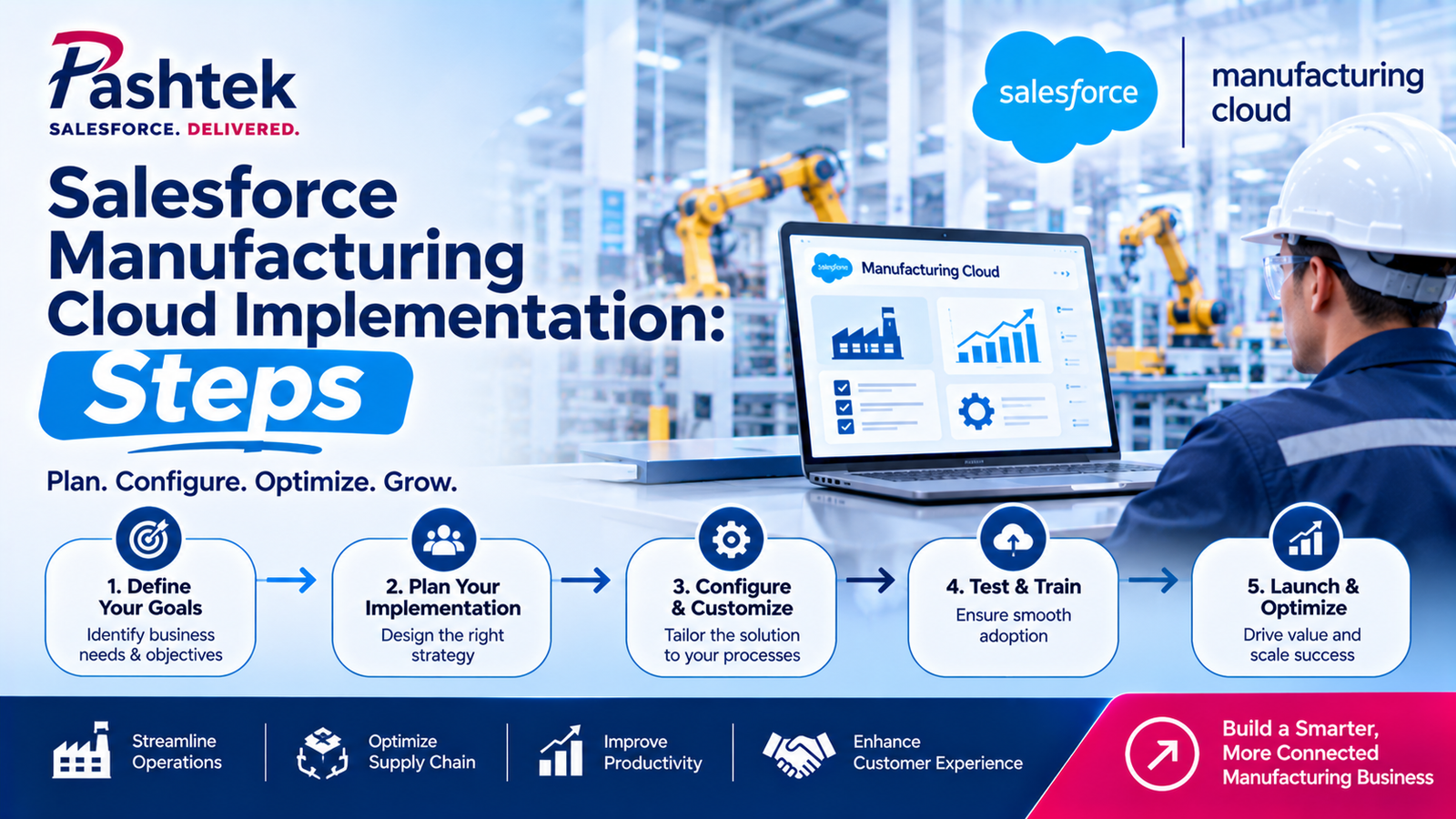
Salesforce Manufacturing Cloud Implementation: Steps
Salesforce Manufacturing Cloud implementation works best when it starts from the contracts you already have with repeat buyers, not from a feature list. Pashtek, a Salesforce consulting partner in Chandler, Arizona, helps US manufacturers plan that rollout, and this guide walks through the steps in order.
The short answer: a Manufacturing Cloud implementation usually moves through six phases: discovery, data model design, configuration, integration with your ERP, testing and training, then go-live with hypercare. The longest phase is rarely the build. It is getting sales, finance and operations to agree on what a sales agreement and a forecast mean.
What is Salesforce Manufacturing Cloud?
Manufacturing Cloud is a Salesforce industry cloud for manufacturers that sell on repeat or contract terms. Its core pieces, as Salesforce documents them in Trailhead, are sales agreements (committed volumes and prices over a period), account forecasting based on those agreements, and targets for account managers. The point is to see planned versus actual sales by account without rebuilding the numbers in spreadsheets.
It is a fit when a large share of revenue comes from repeat orders with distributors, OEMs or key accounts. It is a weaker fit for one-off project sales, where standard Sales Cloud and CPQ may do the job.
Before you start: is Manufacturing Cloud the right fit?
Ask these four questions first.
- Do you sign annual or multi-year agreements with committed volumes?
- Does your forecast today live in spreadsheets that finance and sales both distrust?
- Do account managers need to see actual orders against plan without asking operations?
- Is your ERP the source of truth for orders and shipments, and can it share that data?
If the answer to most of them is yes, the platform matches how you sell. If not, a smaller Sales Cloud project may be the better first step.
The six phases of a Manufacturing Cloud implementation
1. Discovery and agreement mapping
The team documents how agreements are written today: terms, price rules, volume commitments, renewal triggers and who approves exceptions. The output is a map from your real agreements to Salesforce sales agreement fields. This is where most surprises appear, so Pashtek runs it as a workshop before it fixes a price.
2. Data model and security design
Decide which accounts, products, price books and order records the system needs, which fields are required, and who can see what. Plant managers, regional sales leads and finance usually need different views of the same account.
3. Configuration
Configure sales agreements, forecasting, account manager targets and the page layouts each role uses. Prefer configuration over custom code. Each custom component is something your team owns after go-live, and Pashtek’s Salesforce development team writes code only where standard features fall short.
4. ERP and data integration
Actual orders and shipments have to flow into Salesforce, or the planned-versus-actual view means nothing. That usually means an integration with SAP or another ERP, built on middleware such as MuleSoft or through SAP integration. Decide early whether the sync is real-time or batch, and who fixes a record that fails.
5. Testing, migration and training
Load a copy of real agreements and order history, then have account managers test against questions they ask every week: “Is this customer on track for the year?” Train by role, not by feature.
6. Go-live and hypercare
Launch in stages if you can, for example one region or product line first. Plan a hypercare period where the team fixes what real use exposes. Ask any partner whether hypercare is inside the fixed price.
How long does a Manufacturing Cloud implementation take?
There is no published benchmark we can cite for this product, so treat any number as an estimate for your scoping call. Timeline moves with the number of agreement types, the ERP integration and how quickly your team signs off on designs. A single-region rollout with one ERP feed is a smaller job than a multi-plant, multi-ERP program. Pashtek confirms a timeline in its written proposal after the discovery workshop.
What drives the cost?
Cost follows scope more than company size. The biggest drivers are the number of integrations, data migration effort, how many agreement and pricing variants you have, and compliance needs. For general budget ranges across Salesforce projects, see Pashtek’s guide to Salesforce implementation cost. Manufacturing Cloud licensing is separate from services, so confirm current license terms with Salesforce.
Common pitfalls
- Treating the ERP as an afterthought. Without actual order data, forecasting is just a prettier plan.
- Copying every spreadsheet column into Salesforce instead of deciding which fields people use.
- Skipping change management. Account managers who keep a private spreadsheet will starve the system of trust.
- Launching everywhere at once, with no pilot group to find problems first.
- No owner after go-live. Pashtek offers month-to-month managed services for teams that do not want a full-time admin hire.
Planning a rollout? Pashtek can review your agreements, ERP and timeline in a free 30-minute call. Book a time.
How to choose a Manufacturing Cloud partner
- Ask for a manufacturing project they have delivered, and what the integration looked like.
- Ask who does the work, and whether the same people run the discovery workshop and the build.
- Ask how they price: fixed price after discovery is easier to compare than open hours.
- Ask what happens after go-live, and how support is priced.
The guide to choosing a Salesforce implementation partner has a longer checklist.
Frequently asked questions
What is a Salesforce Manufacturing Cloud implementation?
It is the project of configuring Manufacturing Cloud for how you sell on repeat terms: sales agreements, account forecasting, targets and the ERP data that feeds them. Pashtek runs it in phases from discovery to hypercare.
Who should use Manufacturing Cloud?
Manufacturers with recurring or contract-based sales to distributors, OEMs and key accounts, where planned versus actual volume matters.
Does Manufacturing Cloud need an ERP integration?
In practice, yes. Actual orders and shipments usually live in the ERP, and the forecast view needs them. Pashtek builds SAP and MuleSoft integrations.
How long does it take?
It depends on agreement variants, integrations and decision speed. Pashtek gives a timeline in a written proposal, usually about five business days after the discovery workshop.
How does Pashtek price a Manufacturing Cloud project?
Fixed price after a discovery workshop, so scope is clear before you sign.
Can Pashtek support the system after go-live?
Yes. Pashtek offers month-to-month managed services for administration and enhancements.
Talk to Pashtek about Manufacturing Cloud
Pashtek is a Salesforce consulting partner in Chandler, Arizona, serving US manufacturers. Book a free 30-minute consultation or contact Pashtek with your agreement types, ERP and target date. You can also read more about the Salesforce implementation service.